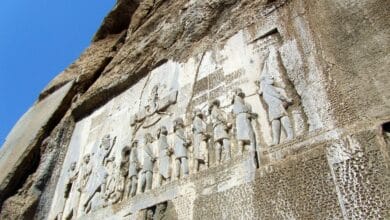

Embark on a journey to the heart of the Achaemenid Empire with hamintour, your trusted guide to Iran’s historical treasures. The Bisotun Inscription, also known as the Behistun Rock, stands as the world’s largest rock inscription and a UNESCO World Heritage Site since 2006. Carved into a towering cliff in Kermanshah, Iran, during the reign of Darius I (522–486 BCE), this monumental masterpiece narrates the king’s triumphs and the Achaemenid legacy. With hamintour, uncover the secrets of this ancient marvel, where cuneiform scripts and vivid reliefs etched in limestone reveal Persia’s grandeur, making it an unmissable stop on your 2025 Iranian odyssey.
The Text of the Bisotun Inscription
The Bisotun Inscription, measuring 20.5 meters long and 7.8 meters wide, is a multilingual chronicle written in three cuneiform scripts: Old Persian, Elamite, and Akkadian. Often likened to the Rosetta Stone for its role in deciphering cuneiform, it recounts Darius I’s rise to power in his own words. The text details his victory over Gaumata, a usurper claiming to be Bardiya, son of Cyrus the Great, and his subsequent quelling of nine rebellions across the empire. Spanning five columns below the relief, it covers:
- Darius’s introduction and Achaemenid lineage
- Restoration of kingship to the Achaemenids
- Gaumata’s rebellion and execution
- Suppression of revolts in 19 battles
- Establishment of peace and governance principles
- Gratitude to Ahura Mazda for divine support
This narrative, preserved for over 2,500 years, offers a firsthand glimpse into Achaemenid politics, brought to life through hamintour’s expert-guided tours.
The Relief: A Visual Triumph
Above the inscription, a striking 6-meter-long, 3.2-meter-high relief depicts Darius I’s dominance. On the left, Darius stands 181 cm tall, his right hand raised in reverence to Ahura Mazda, the Zoroastrian deity hovering with an eight-pointed star crown. Behind Darius, two courtiers wield spears and bows, symbolizing loyalty. To the right, nine bound rebels, each 126 cm tall, stand chained, with Gaumata lying defeated under Darius’s foot—a powerful image of victory. Each rebel’s name and rebellion location are inscribed above, reflecting the empire’s diverse regions.
The figures’ attire highlights cultural distinctions: Darius and his courtiers wear flowing Persian robes and strap sandals, with the king’s rectangular beard crafted from a separate stone. The rebels’ varied clothing underscores their ethnic diversity. hamintour’s guides illuminate these details, connecting the relief’s artistry to Persia’s multicultural empire.
Crafting the Bisotun Inscription
Carved into a polished limestone cliff 10 meters above ground, the Bisotun Inscription was a feat of ancient engineering. Artisans likely used a now-lost staircase or scaffolding, with carved stones below suggesting a construction pathway. To preserve the work, lead was applied to the surface, traces of which remain despite natural wear. Over centuries, damaged sections were meticulously replaced, maintaining the inscription’s clarity. Its elevated position on Mount Bisotun, chosen for its symbolic grandeur, ensured its visibility across the ancient Royal Road. hamintour’s visits include insights into this engineering marvel, blending history with adventure.
Nearby Attractions in Bisotun
The Bisotun complex is a treasure trove of history, with hamintour offering curated tours to nearby sites:
- Statue of Hercules: A 2nd-century BCE Seleucid relic, showcasing Greek influence.
- Farhad Tarash: A massive unfinished rock relief from the Sassanian era.
- Parthian Reliefs: Depicting King Balash and Gudarz, adding to the site’s narrative.
- Sassanian Palace and Bridge: Ruins reflecting later Persian dynasties.
- Cave of Hunters and Tapeh Naderi: Prehistoric and medieval remnants.
- Ilkhanid Caravanserais: Historic rest stops along trade routes.
- Bisotun Lake: A serene spot for reflection amid ancient ruins.
These sites, within a short radius, make Bisotun a cultural hub for explorers with hamintour.
Planning Your Visit with hamintour
Location and Access: Located in Bisotun, Kermanshah, 30 km northeast of Kermanshah city, the inscription is accessible by car or bus from Tehran (500 km) or Kerman (1,200 km). hamintour arranges seamless transfers and guided tours.
Best Time to Visit: Spring (March–May) and autumn (September–November) offer mild weather (15–25°C), ideal for exploring the cliffside. Summer can be hot (up to 35°C), so early mornings are best.
Visiting Hours: Open daily from 8 AM to 6 PM, except on major holidays. Allocate 1–2 hours for the inscription and nearby sites.
Accommodations: Stay in Kermanshah’s modern hotels or traditional guesthouses, recommended by hamintour, for comfort and proximity.
Why Visit the Bisotun Inscription with hamintour
The Bisotun Inscription is more than a rock carving—it’s a gateway to understanding the Achaemenid Empire’s might and Darius I’s legacy. Its UNESCO status, multilingual script, and vivid reliefs make it a global historical treasure. With hamintour, your visit is enriched with expert storytelling, tailored itineraries, and access to Kermanshah’s broader cultural tapestry, ensuring a profound connection to ancient Persia in 2025.
Frequently Asked Questions About the Bisotun Inscription
- Where is the Bisotun Inscription located? It’s in Bisotun, Kermanshah Province, Iran, carved into a cliff 30 km northeast of Kermanshah city.
- What is written on the Bisotun Inscription? Written in Old Persian, Elamite, and Akkadian, it narrates Darius I’s victory over Gaumata, his rise to power, and the suppression of nine rebellions, with praise for Ahura Mazda.
- What is the prominent relief on the Bisotun Inscription? The relief depicts Darius I standing over the defeated Gaumata, with nine bound rebels and Ahura Mazda above, symbolizing royal triumph.
- When was the Bisotun Inscription created? It dates to around 520 BCE during Darius I’s reign, post his victory over Gaumata.
- Why is the Bisotun Inscription significant? Its multilingual text aided in deciphering cuneiform, earning it UNESCO status in 2006.
- How was the inscription carved? Artisans used scaffolding or a staircase to carve it into a limestone cliff, with lead coating for preservation.
- What are nearby attractions? The Statue of Hercules, Farhad Tarash, Sassanian ruins, and Bisotun Lake, all accessible via hamintour.
- What is the best time to visit? Spring and autumn offer ideal weather for exploring the site comfortably.
- How long does a visit take? Plan 1–2 hours to explore the inscription and nearby ruins with hamintour’s guides.
- What does the Farvahar symbol represent? Depicting Ahura Mazda, it signifies divine blessing and Zoroastrian reverence, mirrored by Darius’s raised hand.
With hamintour, your journey to the Bisotun Inscription becomes an immersive exploration of ancient Persia’s enduring legacy, etched in stone and time.