

Turkey Hair Transplant Photos: How to Judge Results
A dramatic before-and-after picture can make you stop scrolling. It cannot tell you whether the patient was a good match for your hair, whether the donor area was left healthy, or who actually performed the surgery. Here is a practical way to ask better questions before choosing a clinic in Turkey.

Short answer: A useful photo set shows the same person at a stated stage of recovery, from comparable angles and lighting, with the hairline, crown and donor area visible. Ask what else changed: medication, a second procedure, hair fibers or scalp micropigmentation. Then verify the doctor and facility independently. Photos are evidence to question, not a promise of your outcome. The American Academy of Dermatology (AAD) says results depend largely on the surgeon, and a full head of hair may be unrealistic.
Independent information, not an advertisement. This page does not rank clinics, endorse a surgeon or sell treatment. It helps you inspect claims. Only a licensed doctor and treating facility can make an individual clinical decision after examining you. This guide is not personal medical advice.
The five-minute photo check
Start with the ordinary details. A beautiful final image may be genuine yet unhelpful if the starting point, timing or treatment history is missing. Try these five checks whenever you open a gallery.
- Match the person. Look for consistent facial features, hair texture and scalp landmarks. Cropped faces can protect privacy, but they make matching harder. Ask for a continuous set from the same case, shared with patient consent.
- Find the interval. An “after” photo should say how long after surgery it was taken. A surgery-day picture shows placement, not established growth. The AAD says many patients see results between six and nine months; some take 12 months.
- Compare like with like. Camera angle, distance, lighting, hair length, wetness and styling should be similar enough to make a comparison meaningful. If they are not, ask for matched views.
- Look beyond the headline image. Request front, top, both temples, crown and donor-area photographs. A strong frontal hairline shot says little about the back of the scalp.
- Ask what else contributed. Was there another transplant, medication, hair fibers, a hairpiece or scalp micropigmentation? A transparent provider will distinguish surgery from other changes.
This is a screening routine, not a scientific score. One missing angle is a reason to ask, not proof of deception. Even well-matched photos cannot predict your result: hair caliber, curl, color contrast, pattern of loss and donor supply differ. The International Society of Hair Restoration Surgery (ISHRS) explains why patient-to-patient comparisons are limited.

When does an “after” photo mean more?
Hair transplantation has a calendar, and galleries often leave it out. According to the AAD patient guide, transplanted hair may shed between two and eight weeks. By month three, the area can look thinner than it did before surgery. Many patients see results at six to nine months, while some take 12 months. People do not heal on identical schedules; ask your doctor what follow-up point is appropriate for judging your case.
| Stage shown | What the picture may show | What it does not establish |
|---|---|---|
| Before surgery | Baseline loss and donor supply, if the views are complete | Medical suitability without an examination |
| Procedure day | The proposed hairline and immediate placement | Long-term growth |
| Early weeks to month three | Healing and possible shedding | A final result |
| Six to nine months | Developing coverage in many patients | That everyone has reached the same endpoint |
| Around 12 months | A more useful longer-term comparison for many cases | How untreated hair will change later |
Do not call a sparse-looking early picture a failure or a full-looking surgery-day picture a success. If your own healing worries you, contact the treating team rather than diagnosing yourself against somebody else’s gallery. The AAD also notes that existing hair loss can continue after a transplant; a dermatologist may discuss treatment for the remaining hair.
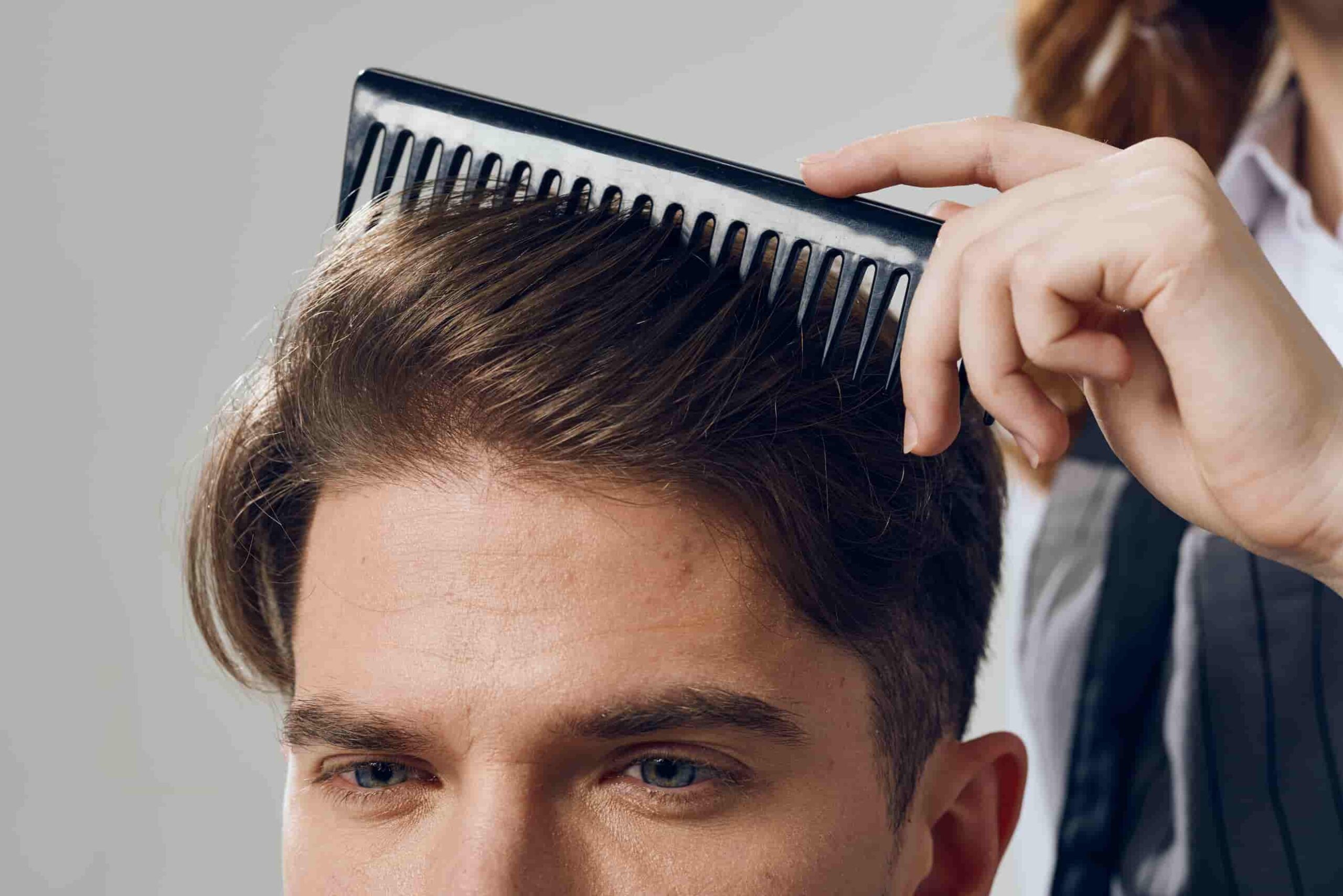
How photography changes what you think you see
Lighting and exposure
Overhead or side lighting can reveal scalp; softer frontal light can hide it. Exposure and contrast settings also alter the impression. Neither lighting condition is dishonest in itself. The problem is presenting unmatched conditions as a controlled comparison. ISHRS material on clinical photography recommends using the same camera, position and lighting in before-and-after images. See its photography discussion.
Hair length, wetness and styling
A longer haircut can cover more scalp even without more follicles. Combing forward can conceal a thin temple; hair fibers can add apparent coverage. Ask for dry, unstyled hair at similar lengths, and perhaps a short video under ordinary light. Video adds context but still cannot prove that nothing was edited or added. An ISHRS journal discussion specifically warns that longer hair in an after image can create an illusion of greater coverage.
Framing
Check whether both images show the same amount of forehead and scalp. A close crop of the new hairline beside a distant preoperative shot exaggerates its impact. A frontal pose tells you little about the crown. Ask for the original uncropped sequence when available, while respecting a patient’s wish to protect their identity.

Read the whole scalp, not just the front
Hairline: Look at shape, transition and direction. A line that looks convincing from the front can feel less natural from the side. Ask for temple close-ups and a photograph with the hair brushed back. A surgeon should explain how a plan fits your face and possible future loss rather than copying a celebrity photograph.
Mid-scalp and crown: These zones can disappear beneath styling. Ask what was actually treated. If a gallery claims dramatic improvement everywhere, ask whether the result followed one procedure or several, and whether medication was involved.
Donor area: Grafts come from a limited supply. Request clear back and side views before and after surgery, including a short-hair view if that matches how you wear your hair. A picture cannot measure remaining graft supply, but it can start a discussion about extraction pattern, scarring and future options. ISHRS cautions against calling FUE “scarless” in its consumer alert on misleading advertising.
Consistency across cases: Do not decide from one spectacular patient. Request several cases with hair-loss patterns and hair characteristics similar to yours, including average-looking results. A clinic that explains why a particular photo is not a fair comparison may be more useful than one with a hundred polished thumbnails.

Where can you examine real before-and-after cases?
Start at an original gallery, not a copied social-media collage. The American Society of Plastic Surgeons (ASPS) hair-transplant gallery says its cases are submitted by member surgeons and cautions that another patient may not get the same result. One individual case attributed to an Istanbul surgeon names the surgeon and describes a one-year follow-up. Treat the reported graft count, technique and timing as the submitting surgeon’s account, not independently audited data.
A clinic gallery can show its visual style, but it is a selected sample. Reviews and patient forums can broaden the picture, yet anonymous posts can be incomplete or impossible to authenticate. Cross-check the same case, the doctor’s name and the facility. If a photo appears on multiple sites under different names, ask the publisher where it originated. A reverse-image search may flag reuse; it cannot, on its own, prove that a result is genuine or fraudulent.
About the photographs on this page: Our on-site images are contextual illustrations, not verified surgical outcome pairs. We do not ask you to judge a Turkish provider from them. Follow the original case galleries above and request fuller documentation from any clinic you are seriously considering.
Make a fair record of your own starting point
Before a consultation, take your own front, left-temple, right-temple, top, crown and donor-area photographs. Use a plain background and ordinary light. Keep the camera at roughly the same distance and height in every view; photograph dry hair without fibers, gel or a strategic comb-over. You do not need a professional camera. The point is to give the doctor a consistent baseline and to make later conversations less dependent on memory.
Label the files privately by view and interval rather than relying on a phone gallery’s order. If a clinic requests images remotely, ask who can access them and how they will be stored. Do not post another patient’s photographs or your own identifying medical details publicly just to get an opinion. A remote image review can help prepare a consultation, but the treating physician may still need an in-person scalp examination before finalizing a plan. That distinction matters especially when a package is being offered before anyone has examined the donor area.
What if a clinic will not share another patient’s photos?
Patient privacy is a legitimate reason not to release an identifiable file. Ask whether the clinic can show consented, de-identified cases during a consultation or explain its photographic documentation process. A refusal to share a particular patient’s image is not evidence of poor surgery. A refusal to discuss timing, views, the treating team or realistic expectations is a different concern. Separate those two situations when making your notes.

Check the clinic behind the photographs
Pictures should open a conversation, not end your research. Ask for the full name of the doctor who will assess you, design the hairline, carry out each surgical step and deal with complications. ISHRS recommends asking exactly who will operate and what each team member will do. A familiar doctor pictured on a website is not proof that they will perform your procedure.
For Turkey, match the facility’s legal name and address against the Turkish Ministry of Health’s lists of providers authorized for international health tourism. Those lists separate hospitals, medical centers, private practices and other facilities. You can also compare facility details with the official HealthTürkiye facility list. Listing does not certify a surgeon’s results, and status can change. Verify the exact legal entity directly before paying.
After a medical assessment, request a written plan: diagnosis, donor evaluation, technique, proposed graft range, who does what, surgery site, aftercare and who responds if trouble occurs after you return home. A photograph or online graft calculator is not an individual prescription. The AAD explains that hair loss has different causes and that examination, and sometimes tests, may be needed.
Ask for an itemized written quote in Turkish lira (TRY) and, if you need it, a US-dollar (USD) equivalent with the exchange-rate date and method. Check what is included: consultation, anesthesia, medicines, follow-up, a possible revision, transfers and accommodation. We do not print an unverified average price here; treatment scope and currency conversion vary, and a photograph cannot establish what your case should cost.
Pause before paying if a clinic will not name the operating doctor, cannot tell you where surgery occurs, promises the same outcome as a gallery patient, calls surgery risk-free, or offers only a heavily styled final photo with no baseline. Each concern calls for an answer, not an automatic verdict.

Questions to send a clinic
You can use this list in an email or consultation. A specific answer is more useful than another carousel of perfect hairlines. If a clinic cannot answer immediately, ask it to follow up in writing instead of filling the gap with assumptions.
- Can you show several complete, consented cases with a pattern of loss and hair type similar to mine?
- For each case, what are the intervals between the before, surgery-day and follow-up images?
- Are the photos comparable in light, angle, distance, hair length and styling?
- May I see donor area, temples, top and crown, not only the front?
- Did this patient use medication, fibers, micropigmentation or another transplant?
- Who diagnosed that patient’s hair loss, and who would assess mine?
- What are the names and professional roles of everyone performing surgical steps for me?
- At what exact facility will I be treated, and under what legal name is it authorized?
- How will follow-up work when I fly home, and whom do I contact about complications?
- Can you provide an itemized quote and cancellation or revision terms before a deposit?
The answers may show that the patient in the photo had a very different starting point from yours. That is useful information, even if the right choice is to wait, investigate the cause of loss or seek a second medical opinion. Keep copies of the plan and quote so that you can compare what was promised with what is actually offered later.
Still unsure which option is right for you?
If you’re still having difficulty making a decision after reading this article, simply fill out the form below. Our advisors will review your needs and circumstances completely free of charge and provide you with suitable options and a personalized treatment plan based on your needs and expectations.
About hamintour Medical Guides
hamintour Medical Guides helps international readers ask more precise questions about treatment and travel. This is an information guide, not a clinic advertisement or a substitute for consultation. Our aim is deliberately modest: make it harder for one impressive image to carry more weight than its evidence deserves. Learn more about us and our editorial standards.
Use our provider guides as starting points for checking, not as endorsements: Turkey medical guides, Turkey clinic comparison, and city guides for Istanbul, Ankara, Antalya and Izmir. Check current facility and doctor claims at their original sources before booking.
Frequently asked questions
Can two photos prove that a hair transplant worked?
Not reliably. They may suggest visible change, but without comparable conditions, timing, treatment history and donor views they cannot establish the full result or predict yours.
When should I expect a meaningful result photo?
The AAD says many people see results between six and nine months and some take 12 months. Early photos can show healing, but shedding in the first weeks and temporary thinness around month three make them unsuitable as final comparisons.
Does a large graft count prove a better result?
No. A gallery’s number is generally a provider-reported detail, not a measured outcome. Diagnosis, donor supply, coverage goals and the treating doctor’s judgment matter to an individual plan.
Are clinic gallery photos fake?
Some show genuine patients; a gallery alone cannot authenticate itself. Look for the original publisher, a named treating team, consistent follow-up and enough context for fair comparison. Ask before inferring either fraud or quality.
Should I trust Google or Trustpilot reviews instead?
Use reviews as a supplementary signal about communication and service, not proof of clinical outcomes. Check that a review profile belongs to the exact legal clinic or doctor you are considering.
Can a strong photo set guarantee the same result for me?
No. Hair characteristics, donor supply and causes of loss differ. A licensed doctor must assess whether transplantation is suitable and discuss realistic expectations for your case.
Your next step
Choose two or three original case galleries and run the checklist. Ask each clinic for comparable cases, the named treating doctor, the exact facility and a written care plan. A photograph should help you prepare for a medical conversation, not replace one. For questions about researching options, contact hamintour Medical Guides or message us on WhatsApp.