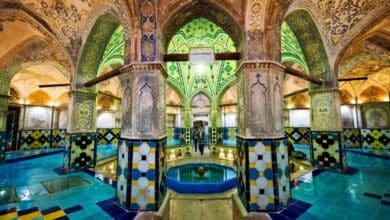

Kashan, a gem in Iran’s central Isfahan Province, enchants with its rose-scented gardens, mud-brick mansions, and Silk Road legacy, drawing wanderers to its labyrinthine bazaars and ancient oases. At the heart of this poetic city lies the Sultan Amir Ahmad Bathhouse, a mesmerizing 16th-century Safavid-era masterpiece that whispers tales of communal rituals, opulent hygiene, and architectural genius. Spanning 1,102 square meters in a historic neighborhood, this bathhouse—named after the nearby Imamzadeh Sultan Amir Ahmad, grandson of Imam Jawad—blends Seljuk foundations with Qajar renovations, showcasing turquoise-gold tiles, seven-layer plasterwork, and convex-glass domes that filter light like scattered jewels. Registered as a national heritage site in 1976, it attracts over 200,000 visitors yearly, offering a serene escape from Kashan’s arid heat. hamintour, your premier curator of Iran’s cultural odysseys, crafts immersive tours here, blending guided explorations of its kaleidoscopic interiors with rosewater tastings and rooftop panoramas, ensuring a 2025 visit feels like stepping into a living Persian poem. Whether you’re tracing the footsteps of French explorer Jean Chardin, who praised Kashan’s “excellent and clean” baths in the 17th century, or capturing its iconic rooftop silhouette against the Alborz foothills, this landmark elevates any itinerary into a sensory celebration of Iran’s bathing heritage.
The Storied Waters of Sultan Amir Ahmad: A Bathhouse Born of Empires
The Sultan Amir Ahmad Bathhouse emerged in the 16th century during the Safavid dynasty’s golden age, a period when Shah Abbas I transformed Isfahan—and its satellites like Kashan—into hubs of art and commerce along the Silk Road. Though some traces suggest Seljuk roots from the 11th century, the core structure crystallized under Safavid patronage, serving as a vital social nexus where merchants, poets, and pilgrims converged for purification rituals tied to Islamic traditions of cleanliness and community. A devastating 1778 earthquake ravaged the site, prompting extensive Qajar-era reconstructions around 1875, which infused it with lavish tilework and expanded the Sarbineh (changing room). By the 19th century, it embodied Kashan’s role as a merchant powerhouse, where affluent traders funded such opulence amid rose distilleries and carpet looms. In 1996, Kashan’s municipality spearheaded a meticulous restoration, preserving its lime-plaster layers—up to 17 in places—and converting it into a museum that evokes its past as a teahouse and gathering spot. hamintour’s historical narratives during tours reveal lesser-known facets, like how these baths facilitated pre-wedding ceremonies and Sufi meditations, turning a simple soak into a cultural rite. Today, in 2025, with enhanced LED accents highlighting nocturnal tile glimmers, the bathhouse stands resilient, a UNESCO-tentative site symbolizing Iran’s fusion of utility and artistry across dynasties.
Architectural Symphony: Designs That Defy Time and Heat
Sultan Amir Ahmad’s allure lies in its ingenious engineering, sunk slightly below ground to trap warmth like a subterranean cocoon, while its multi-domed roof—adorned with 12 convex glass oculi—bathes interiors in ethereal, diffused light without compromising privacy. Crafted from bricks, stone, and lime mortar, the 1,000+ square meters feature symmetrical layouts echoing Persian gardens, with winding corridors mitigating thermal shocks for bathers’ health. Exquisite seven-layer stucco reliefs depict floral arabesques, hunting scenes, and mythical birds, interspersed with cobalt-blue tiles in gold filigree that shimmer like a submerged mosaic. The domes, each a microcosm of cosmic harmony, prevent external views while channeling natural ventilation, a Safavid innovation blending Zoroastrian fire symbolism with Islamic geometry. hamintour’s architecture-focused excursions, led by heritage experts, unpack these elements— from the lime’s acoustic properties amplifying echoes of ancient conversations to the tiles’ resistance to Kashan’s 50°C summers—making your visit a masterclass in sustainable Persian design. In 2025, interactive AR overlays via hamintour apps project historical animations of bustling bathers, bridging the gap between relic and revival.
Journey Through the Chambers: From Threshold to Tranquil Depths
Divided into small and large sections for segregated bathing, the bathhouse unfolds like a narrative epic, each chamber a chapter in daily life. hamintour’s sequential tours guide you through these spaces, pausing for reflections on their social roles, from gossip hubs to healing havens.
Forecourt and Entrance (Jelokhan): The Welcoming Threshold
Enter via a modest forecourt off Alavi Street, where the Jelokhan—a vaulted antechamber—ushers visitors with subtle tile motifs of pomegranates symbolizing fertility. This transitional zone, often lined with benches, once buzzed with arrivals depositing outer garments, setting a tone of anticipation. hamintour enhances this entry with welcome rose sherbets, evoking Safavid hospitality.
Portal (Sardar): Guardian of Opulence
The Sardar, a ornate gateway, demarcates public from private realms, its walls alive with vibrant kashi-kari tiles portraying doves, shrubs, and vignettes of urban hunts or noble figures. Floral plaster friezes frame arched doorways, a Qajar flourish adding narrative depth. Here, temperature gradients begin, preparing bodies for the warmth ahead. hamintour’s close-up sessions decode these motifs, revealing coded tales of prosperity and piety.
Vestibule and Winding Corridors (Hashti): Gradual Awakening
An octagonal hashti precedes sinuous passages, their meanders engineered to acclimate bathers slowly—vital in an era without thermostats. Low ceilings and subtle inclines heighten intimacy, with occasional niches for oil lamps casting flickering shadows on stucco vines. These paths, once echoing laughter and steam, now invite contemplative strolls. hamintour pairs this with audio tales of 19th-century merchants negotiating deals mid-scrub.
Changing Room (Sarbineh): Octagonal Oasis of Rest
The heart of the large section, this octagonal hall—Qajar-rebuilt with eight sturdy columns—circles a central pool and marble fountain, where bathers lounged on raised platforms, sipping teas amid turquoise mosaics. Basins at platform edges facilitated foot-washing rituals, while domed ceilings with glass vents create a starry illusion. hamintour’s relaxation stops here include mock “bathing” sessions with herbal infusions, mimicking ancient ablutions.
Caldarium (Garmkhaneh) and Khazineh: The Steaming Sanctum
Beyond, the Garmkhaneh’s hot room, divided by four columns into tripartite zones, features side pools for immersion and a noble’s annex (Khazineh) with private basins heated by subterranean furnaces. Steamy arches and lime-relief peacocks evoke therapeutic vapors, once infused with rose essences for skin rituals. The small section mirrors this for women, underscoring gender-segregated serenity. hamintour’s wellness add-ons explore hydrotherapy echoes, with guides sharing how these spaces fostered social bonds.
The Iconic Rooftop: A Photographer’s Dreamscape
Ascend discreet stairs to the rooftop, a undulating sea of 12 onion domes pierced by bullseye lenses, offering bird’s-eye views of Kashan’s ochre alleys and distant Qamsar mountains. This vantage, a symbol of the city, frames sunsets like a living postcard. hamintour’s drone-free photo ops in 2025 include pro tips for capturing the “Kashan kaleidoscope,” as visitors dub its light-play.
Location and Effortless Access in 2025
Tucked in Kashan’s Sultan Amir Ahmad historic quarter—off Alavi Street in the namesake alley—this bathhouse anchors a cluster of gems like Agha Bozorg Mosque and Tabatabaei House. Reach it via:
- Private Car: 10 minutes from Kashan’s Amir Kabir Square; ample street parking (free, but narrow).
- Public Transport: Bus 7 from the central terminal to Alavi Stop (5-minute walk); taxis via Snapp app (~100,000 IRR from Fin Garden). hamintour’s seamless shuttles from Tehran (3-hour drive) or Isfahan include door-to-door drops, with 2025 e-ticketing for skip-the-line entry at ~200,000 IRR (combo with four mansions: 1,200,000 IRR).
Optimal Timing: When to Immerse in Kashan’s Magic
Kashan’s scorching summers (up to 45°C) make spring (March-May) and autumn (September-November) prime, with May-June’s Golabgiri festival—rose-petal harvesting and distillation—infusing the air with floral symphony and markets with fresh attars. Plan 2 hours for a full tour, extending to 4 with hamintour’s bundled walks to nearby Abbasi House. Avoid Fridays for lighter crowds; 2025’s enhanced cooling mists in peak heat ensure comfort.
Nearby Havens: Luxe Stays and Culinary Delights
Post-bath, unwind at boutique boltholes like Ameriha Hotel’s vaulted suites (from 5,000,000 IRR/night) or Atlasi Guesthouse’s courtyard serenity. Sang Poloy’s traditional vibes offer rose-infused hammams. Savor at Talar-e Ayneh’s mirrored feasts of fesenjan under chandeliers, or Khaneh-ye Noghli’s pistachio-dusted kebabs in a caravanserai. Abbasi Traditional Restaurant pairs live santur music with ghormeh sabzi, while Mozaffari’s rooftop views complement eggplant mirza. hamintour’s gastro-tours link these, curating farm-fresh menus from Qamsar orchards.
Why hamintour Transforms Your Bathhouse Quest
hamintour elevates Sultan Amir Ahmad from sight to story, with intimate groups (max 8), artisan demos of tile-making, and eco-conscious paths supporting Kashan’s heritage funds. Our 2025 packages weave in VR recreations of Safavid soaks and exclusive after-hours access, blending education with enchantment for authentic, unforgettable immersion.
Echoes of Steam: Sultan Amir Ahmad’s Eternal Glow
Sultan Amir Ahmad Bathhouse isn’t merely ruins—it’s Kashan’s beating pulse, where steam once mingled voices in unity, now inviting you to reflect amid timeless tiles. From its light-dappled domes to rose-laced lore, it encapsulates Persia’s genius for beauty in the everyday. With hamintour, your exploration becomes a ritual of discovery, beckoning deeper into Iran’s mosaic of wonders.
Sultan Amir Ahmad Bathhouse FAQs
Where is Sultan Amir Ahmad Bathhouse located? In Kashan’s historic Sultan Amir Ahmad neighborhood, off Alavi Street in the Sultan Amir Ahmad Alley—a short walk from Agha Bozorg Mosque.
What are the main parts of the Sultan Amir Ahmad Bathhouse? Key sections include the Jelokhan entrance, Sardar portal, Hashti vestibule, octagonal Sarbineh changing room, Garmkhaneh hot room with Khazineh annex, and the multi-domed rooftop.
What is the best time to visit Sultan Amir Ahmad Bathhouse? Spring (March-May) and autumn (September-November), especially May-June during Golabgiri rose festival; allocate 2 hours, with hamintour tours for extended cultural depth.
What is the entry fee for Sultan Amir Ahmad Bathhouse in 2025? ~200,000 IRR standalone; opt for a 1,200,000 IRR combo ticket covering four nearby mansions—hamintour bundles save 20%.
Are there guided tours available for the bathhouse? Yes, hamintour offers expert-led walks with AR enhancements, artisan interactions, and transport, ideal for history and architecture enthusiasts.
Can I visit the rooftop of Sultan Amir Ahmad Bathhouse? Absolutely—access via internal stairs for panoramic Kashan views; hamintour’s photography sessions capture its iconic domes at golden hour.