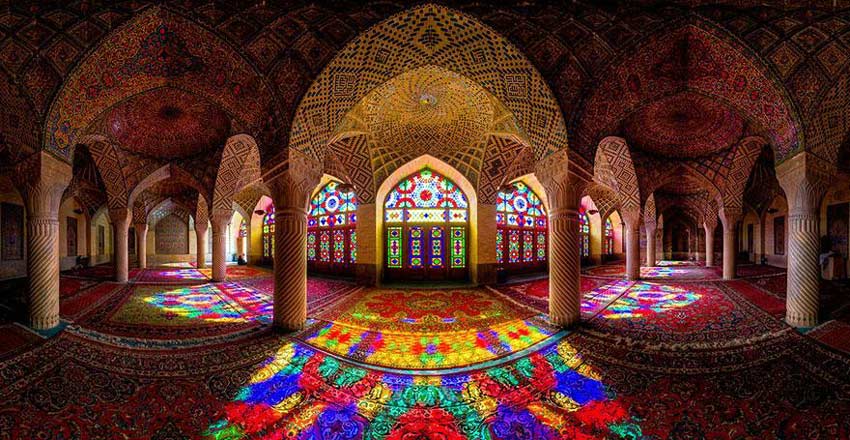

Nasir al-Mulk Mosque: A Stunning Gem in Shiraz
Nasir al-Mulk Mosque is one of the most captivating attractions in Shiraz, especially in recent years when the trend of selfies and mobile photography has grown. It’s rare for someone to visit Nasir al-Mulk Mosque and not take a photo with its stunning stained-glass windows.
When thinking about the must-see places in Shiraz, the famous Vakil Bazaar and Eram Garden often come to mind. However, don’t forget to visit Nasir al-Mulk Mosque, which offers a unique experience. While there are many historic mosques in Iran, such as the Blue Mosque in Tabriz, the historic mosques in Isfahan, or the Vakil Mosque, Nasir al-Mulk Mosque will completely change your perception of mosque architecture. Known as the “Pink Mosque,” this stunning structure is filled with pink tiles and colorful glass windows that create a mesmerizing play of light. In this article from Hamintour, we explore the beauty, history, and best times to visit Nasir al-Mulk Mosque.
Where is Nasir al-Mulk Mosque?
You can find the “Pink Mosque” of Iran in the city of Shiraz, in the southern part of Lotfali Khan Zand Street, in Nasir al-Mulk Alley, in the historic Gud Araban neighborhood. This mosque is one of Shiraz’s most beautiful landmarks, and the memories of visiting it will stay with you forever.


History of Nasir al-Mulk Mosque
Nasir al-Mulk is the title of Mirza Hasan Ali Khan, the governor of Fars, who ordered the construction of the mosque in 1255 in the Persian calendar (1876 in the Gregorian calendar). He came from the renowned Qavam family of Shiraz and was the son of Qavam al-Mulk.
As indicated by his name, Nasir al-Mulk belonged to the aristocracy. He was known by the people as a just ruler who dedicated a significant portion of his wealth to charity. Interestingly, the descendants of Nasir al-Mulk continue to use the income generated by the mosque today for charitable purposes.


If you read the inscription of the mosque, you will see that the names of Haj Mohammad Hassan, the architect, and Mirza Reza, the tile craftsman, are credited for the mosque’s construction. It took 11 years to complete the construction and decoration of the building, finishing in 1266 in the Persian calendar (1887 Gregorian), but without its famous stained glass windows.
It is likely that Master Haj Mirza, who designed and installed the stained glass windows a few years later, knew he had created something valuable. However, he may not have imagined that many years later, tourists from various cities and countries would be drawn to the play of color and light from the stained glass windows of Nasir al-Mulk Mosque.


What are its features?
When you stand in front of the grand wooden doors of the mosque and look up, the muqarnas work of the large archway will catch your eye. The seven-colored tiles are not unlike those in other mosques, but the presence of the pink color here immediately draws attention. All the tiles in this building are naturally colored.
As you step into the brick vestibule, you enter the mosque’s courtyard, which is open and stunning. The central pool, the surrounding flowerpots, and the buildings—while impressive—may not seem vastly different from those of other mosques. But this is just the beginning of the story.


In the north of the courtyard, you will find the Pearl Arch, while in the south, you will see the southern iwans and the minarets. The northern and southern iwans do not appear entirely symmetrical, as no minaret is designed in the north. To the east, there is the cow-well and a prayer hall with seven colorful columns. In the northeast of the courtyard, you’ll find another space where the Chain Mausoleum is located.
Now, speaking of the western side, this is where all the stories converge—the main prayer hall of Nasir al-Mulk Mosque, whose windows are adorned with colored glass; these glass panes transform the light into a vibrant rainbow of beauty and energy.
Main Prayer Hall
What has made Nasir al-Mulk Mosque famous among tourists is the scenes you see in its main prayer hall. From the ceiling to the windows and columns of the western prayer hall, everything is eye-catching. The tile work is mesmerizing, and when you look up, the ceiling’s intricate decoration will make you want to keep your head tilted back as long as possible, immersing yourself in the beauty. The tiles are adorned with floral motifs and verses written in the Thuluth script.


The columns of the western prayer hall are arranged in two rows of six, a number that recalls the Twelve Imams. The spirals on the columns always capture the attention of tourists.
Between these beautiful columns, there are seven arched niches that collectively create a delightful view. Alongside them, you will find the mihrab, which is slightly lower than the rest of the prayer hall floor and is covered in marble. The decoration of this prayer hall might remind you of the Vakil Mosque, and you’re right in thinking so, as some of the design elements are inspired by it.
However, the beauty of this space is enhanced a hundredfold by the rays of light passing through the stained-glass windows. Seven large windows, with wooden frames and floral-patterned colored glass, adorn the building.
If you visit Nasir al-Mulk Mosque early in the morning, the sunlight streaming through the windows creates a stunning spectacle. The photography and sightseeing opportunities at this time of day are incredibly popular. Many travelers eagerly wake up early in the morning to ensure they don’t miss this extraordinary play of color and light.


The floor of the prayer hall is covered with colorful carpets, and when the light from the windows falls onto the carpets, a vibrant celebration of colors occurs. While some people believe that without the carpets, the play of colors would have been even more captivating, the carpets certainly add to the richness of the experience.
There are several fascinating architectural and decorative details in the prayer hall, such as the stone columns, whose stones were gathered and carved from the surrounding mountains of Shiraz. Another interesting feature is the seven famous windows, a symbolic representation of the seven heavens or the seven gates of paradise.
The stained-glass windows of the prayer hall showcase four primary colors: yellow, blue, green, and red. All of these glass pieces are old, and during their restoration, glass from other old houses was used. In the tiles of Nasir al-Mulk Mosque, you can even spot motifs resembling church designs, a phenomenon that only occurred during the Qajar period.


Eastern Prayer Hall
This is the winter prayer hall, adorned with small tiles on the ceiling and featuring eight arched niches. The Endowment Museum is located within the eastern prayer hall. The entrance to this hall is enhanced with a line from a poem by Saadi, adding to its charm: “The purpose is a trace that remains with us.” Behind the eastern prayer hall lies the path to the water well, or “gauv chah.”


The Water Well (Gav Chah)
Despite the modern conveniences we enjoy today, imagining life two hundred years ago can be difficult. In the past, people sometimes used animals like cows to help draw water from wells. The well at Nasir al-Mulk Mosque has remained from ancient times, and the “Gav Chah” (cow well) was the place where animals were kept to draw water. The water from the well would flow into a small pool and then erupt from the fountain in the mosque’s courtyard.


Pearl Arch (Taq-e Marvarid)
The northern iwan of the Nasir al-Mulk Mosque is known as the Pearl Arch or “Shah Neshin” (Royal Niche). Its ceiling is magnificently adorned with muqarnas (stalactite decoration), and its arched indentations resemble pearls, giving it the name “Pearl Arch.” The entire iwan is decorated with vibrant seven-colored tiles, making it visually striking.
Southern Iwan
The southern iwan or archway has a ceiling similar to the Pearl Arch and is also decorated with muqarnas. However, its distinguishing feature is the minarets, which set it apart from the northern arch. Despite this difference, it shares similar tilework with the northern iwan.
Zanjiri Mausoleum (Imamzadeh Zanjiri)
The Imamzadeh Zanjiri, located in the northeastern corner of the Nasir al-Mulk Mosque courtyard, is the burial site of Sayyid Jalal ad-Din, a descendant of Imam Sajjad. The mausoleum, known for its chain-like design, was constructed during the Safavid era, though some of its decorations were added during the Zand and Qajar periods.


What Foreign Tourists Say About Nasir al-Mulk Mosque
The Nasir al-Mulk Mosque, known as the “Pink Mosque” among foreign tourists, has received rave reviews on travel sites like TripAdvisor. Many visitors share their experiences of visiting this historical site, praising its beauty and the unique experience it offers. For example, Marcel G, who visited in the winter of 2019, wrote: “This place is worth seeing. Everything you’ve heard about it is true! If you want to see the reflection of colors, go between 7:30 and 10 in the morning.”
Duke, who visited from England in late autumn 2019, described it as: “This mosque is a mirror of colors. It is a place that offers an unmatched sense of tranquility.” Greek traveler Alk also commented in the fall: “Find a quiet corner, sit down, and enjoy the celebration of colors!” Armanos, who visited from Switzerland in November 2019, said: “There is no reason to miss this mosque.”


What is the Best Time to Visit Nasir al-Mulk Mosque?
Without a doubt, the best time to visit the Nasir al-Mulk Mosque is early in the morning, right when the doors open to visitors. This is when you can witness the angled sunlight shining through the colored glass windows. According to travelers’ experiences, not only is before 10 AM the ideal time, but the second half of the year also offers a more captivating light angle compared to spring and summer.


Visiting Hours and Ticket Price
In spring and summer, the Nasir al-Mulk Mosque is open from 7:30 AM to 7:00 PM. However, in autumn and winter, the visiting hours change to 7:00 AM to 5:50 PM. Please note that the mosque is closed on days of mourning and public holidays. The entrance ticket was priced at 3,000 Toman in 2019.


Nearby Attractions
Nasir al-Mulk Mosque is located close to some of the most famous tourist attractions in Shiraz. If you enjoy walking, you can reach the Vakil Bazaar in about a 15-minute walk, just 1,300 meters from the mosque. The Vakil Complex will keep you occupied for a few hours. Afterwards, you can visit Shah Cheragh, which is also nearby, for a spiritual experience.