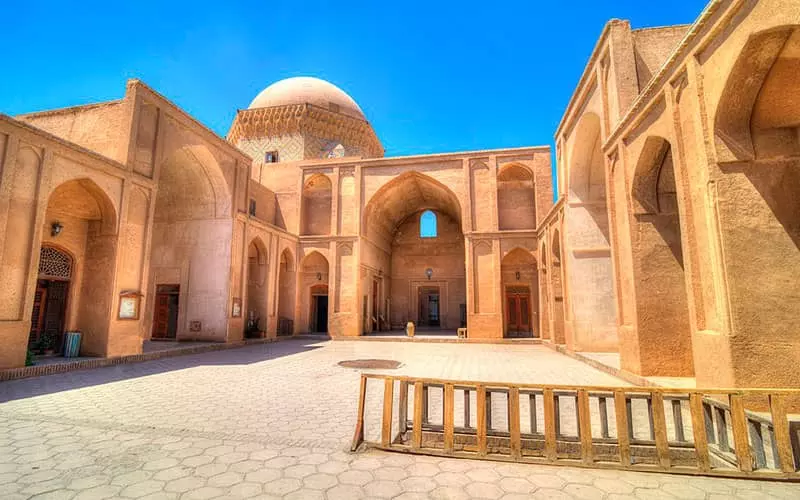

Dive into the heart of Yazd’s ancient Fahadan neighborhood with Hamintour to uncover the enigmatic Alexander’s Prison, also known as Ziaiyeh School. This 15th-century architectural marvel, shrouded in myths and legends, is a must-visit for travelers seeking history, culture, and intrigue. Registered as a National Heritage Site in the 1960s, this iconic structure in Iran’s desert city blends captivating tales with stunning Azari-style architecture. Whether you’re drawn to its mysterious past, intricate mud-brick design, or the vibrant cultural scene of Yazd, Hamintour’s guided tours offer an immersive experience into this UNESCO-recognized city’s timeless allure. Join us to explore Alexander’s Prison and discover why it remains one of Yazd’s most fascinating landmarks.
History of Alexander’s Prison
The history of Alexander’s Prison, or Ziaiyeh School, is a captivating blend of fact and folklore. Named “Zendan-e Eskandar” in Persian, the site is often linked to Alexander the Great, though no definitive evidence ties him to its construction. Local legends suggest that during his conquest of Persia, Alexander used this building as a prison to detain opponents, leveraging Yazd’s remote, desert location to isolate prisoners. Some accounts propose it was originally called “Kisheh” and served as a dungeon for Persian resistors, a notion fueled by a reference in a Hafez poem. However, historical records offer a different narrative, indicating the structure was built as a religious school by the Razi family.
Founded in 1233 (631 Hijri) by scholar Zia al-Din Hossein Razi, the complex was completed in 1305 by his sons, Majd al-Din Hassan and Sharaf al-Din Ali, taking nearly 75 years to finish. During the Al-Muzaffar dynasty, Yazd earned the title “Dar al-‘Ulum” (House of Knowledge), and Ziaiyeh School was a hub for scholars and education, complete with a library and bathhouse. Over time, a deep well in the courtyard, initially mistaken for a dungeon, was revealed to be part of an underground water system, showcasing ancient Iranian ingenuity. Hamintour’s expert guides unravel these myths, offering insights into the site’s dual identity as both a supposed prison and a historic school, making your visit a journey through Yazd’s layered past.
The site’s mystique persists, with tales of Alexander’s prisoners mingling with its scholarly legacy. Post-Islamic Revolution, the building suffered damage but was meticulously restored using raw bricks to preserve its original form, earning its status as National Heritage Site #770. Today, it stands as a testament to Yazd’s resilience and cultural depth, inviting visitors to explore its historical ambiguities with Hamintour’s curated tours.
Architecture of Alexander’s Prison
Alexander’s Prison exemplifies the Azari or Mongol/Iranian-Mongol architectural style, introduced by Master Pirnia and attributed to Azerbaijan’s influence during the Ilkhanid–Timurid eras. This style, characterized by simplicity and functionality, is perfectly suited to Yazd’s arid climate. Hamintour’s tours highlight the architectural ingenuity that makes this structure a standout in Yazd’s UNESCO-listed old city.
Materials
Constructed entirely from mud-brick and clay, the building reflects Yazd’s traditional building techniques, designed to combat the desert’s extreme heat. These materials, combined with minimal decorative elements, ensure durability, with the raw brickwork telling a story of resilience over centuries. During restoration by Ostad Akhoond Khorrami, kiln-dried bricks were added to reinforce the structure, preserving its original charm.
Dome
The centerpiece of Alexander’s Prison is its majestic 18–20-meter-high dome, adorned with remnants of azure and gold plaster, though much of the decoration has faded over time. This dome, similar to that of the nearby Twelve Imams Tomb, is a hallmark of Azari architecture, blending structural strength with aesthetic elegance. Hamintour guides point out its intricate design, offering a glimpse into the craftsmanship of the era.
Windcatcher
A prominent windcatcher (badgir in Persian) stands adjacent to the main building, a quintessential feature of Yazd’s architecture. This ingenious cooling system channels desert breezes into the interior, maintaining a comfortable temperature even in scorching summers. Hamintour’s tours explain how these windcatchers reflect Yazd’s adaptation to its harsh environment.
Well and Basement
A 2.8-meter-deep well in the courtyard leads to a 5-meter-deep cellar (sardab), accessible via a staircase with fewer than 40 steps. Originally used for food storage and heat respite, this feature was once mistaken for a dungeon, fueling the prison myth. Hamintour clarifies these misconceptions, showcasing the cellar’s role in ancient water management.
Praying Hall
The Shabestan, or praying hall, features altars of varying sizes and designs, reflecting the building’s religious significance as a school. This spacious hall, with its serene ambiance, underscores the site’s educational past, which Hamintour’s guides bring to life through engaging storytelling.
The Museum
Inside Alexander’s Prison, a small ethnographic museum captivates visitors with a collection of tombstones, tablets, and archaeological artifacts, some believed to be linked to the Razi family. The museum also features a detailed scale model of Yazd’s old city, offering a bird’s-eye view of its labyrinthine streets. Artisans demonstrate traditional crafts, such as pottery and weaving on wooden looms, showcasing Yazd’s Silk Road heritage. Hamintour’s tours include interactions with these artisans, providing a hands-on experience of Yazd’s cultural traditions. The museum’s cozy café, set in an octagonal pool-adorned basement, offers a tranquil spot to reflect on your visit.
Location & Nearby Attractions
Located in the historic Fahadan neighborhood, Alexander’s Prison is surrounded by Yazd’s most iconic landmarks, making it a perfect stop on Hamintour’s cultural itineraries. Nearby attractions include:
-
Amir Chakhmaq Complex: A stunning 15th-century complex with a three-story facade, ideal for evening visits when lit up.
-
Lariha House Museum: A restored Qajar-era mansion showcasing Persian domestic architecture.
-
Jameh Mosque of Yazd: A 14th-century masterpiece of Azari architecture with towering minarets.
-
Dowlat Abad Garden: A UNESCO-listed Persian garden with the tallest windcatcher in Iran.
-
Yazd Water Museum: A fascinating look at qanats, Yazd’s ancient water systems, housed in a restored mansion.
-
Twelve Imams Tomb: An 11th-century brick tomb adjacent to the prison, featuring inscriptions of Shiite Imams.
-
Heidarzadeh Museum of Coin and Anthropology: A unique collection of coins and cultural artifacts, just 300 meters away.
View Alexander’s Prison on Google Maps.
How to Get to Alexander’s Prison
Reaching Alexander’s Prison is straightforward with Hamintour’s travel guidance. From Yazd’s city center, head to the Clock Tower in the Fahadan neighborhood. From there, take a 15-minute walk north along Rakhtshoor Khane Street, following signs to Imam Square, where the prison is located next to the Twelve Imams Tomb. The historic Fahadan area is best explored on foot, allowing you to soak in the charm of its mud-brick alleys and windcatchers. Public transportation, including buses and taxis from Yazd’s main terminals, is readily available, and Hamintour can arrange private transfers from Yazd International Airport or nearby cities like Isfahan (4-hour drive).
Plan to Visit
Plan your visit to Alexander’s Prison with Hamintour for a seamless experience. The site is open daily from 8:00 AM to 7:30 PM, except on national holidays like religious mourning days. Allocate about 1 hour to explore the prison, museum, and courtyard, then continue your day in Fahadan with nearby attractions. Winter is the ideal season to visit Yazd, offering cooler temperatures to escape the desert heat. After your visit, relax at nearby cafes like Yazd Art House Café or enjoy a meal at traditional restaurants such as Emarat Vakil, Tahmoures Historical Restaurant, or Karizma Café, known for authentic Persian cuisine. Hamintour recommends combining your visit with a stroll through Yazd’s old city, a UNESCO World Heritage Site, to experience its vibrant bazaars and historic charm.
Book your Yazd adventure with Hamintour.
Cultural Significance
Alexander’s Prison is more than a historic site; it’s a symbol of Yazd’s enduring cultural and architectural legacy. Its mud-brick construction and windcatchers reflect the city’s ingenious adaptation to the desert environment, while its historical ambiguity—part prison myth, part scholarly hub—adds to its allure. As part of Yazd’s UNESCO-listed old city, the site embodies the region’s Silk Road heritage, where trade, culture, and innovation converged. Hamintour’s tours highlight this significance, offering insights into Yazd’s role as a center of learning and resilience, with artisans and guides bringing its stories to life.
Why Choose Hamintour?
Hamintour transforms your visit to Alexander’s Prison into a memorable cultural journey. Our personalized tours include expert guides who unravel the site’s myths and history, comfortable transportation, and curated itineraries covering Yazd’s top attractions. Whether you’re a history buff, architecture enthusiast, or simply seeking a unique travel experience, Hamintour ensures a seamless and enriching adventure. Stay in nearby traditional hotels like Fahadan Museum Hotel or modern options like Dad 4* Hotel, arranged through Hamintour for an authentic Yazd experience.
Conclusion
Alexander’s Prison, or Ziaiyeh School, is a captivating blend of history, architecture, and mystery in Yazd’s historic Fahadan neighborhood. Its Azari-style dome, windcatcher, and ethnographic museum offer a window into Iran’s cultural heritage, while its myths of Alexander the Great add intrigue. With Hamintour, explore this National Heritage Site and nearby landmarks like the Jameh Mosque and Dowlat Abad Garden, immersing yourself in Yazd’s UNESCO-listed old city. Book your tour today to uncover the secrets of Alexander’s Prison and experience the timeless charm of Yazd with Hamintour.
FAQs
Where to eat near Alexander’s Prison?
Enjoy authentic Persian cuisine at nearby restaurants like Emarat Vakil, Tahmoures Historical Restaurant, or Karizma Café, all within walking distance in Fahadan. Hamintour can recommend the best dining spots.
How many years did it take to build Alexander’s Prison?
The structure was built over 75 years, from 1233 to 1305, by Zia al-Din Hossein Razi and his sons, Majd al-Din Hassan and Sharaf al-Din Ali.
Where to buy souvenirs near Alexander’s Prison?
Visit handicraft shops within the prison complex or explore the nearby Khan Bazaar for traditional Yazd termeh (silk and wool fabrics), pottery, and carpets. Hamintour’s guides can lead you to the best local artisans.