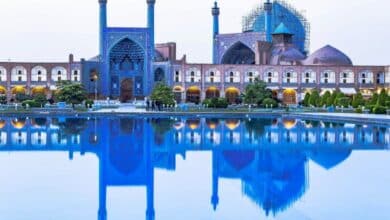

Why Explore Shah Mosque in 2025?
Nestled in Isfahan’s iconic Naqsh-e Jahan Square, a UNESCO World Heritage Site, the Shah Mosque—also known as the Imam Mosque or Abbasid Grand Mosque—stands as a pinnacle of Persian architectural brilliance. Commissioned in 1611 by Shah Abbas I during the Safavid dynasty and completed in 1629, this 17th-century masterpiece blends intricate tilework, towering minarets, and a majestic double-shelled dome, captivating art lovers and history enthusiasts. In 2025, with enhanced night illuminations and new cultural festivals in Isfahan, the mosque shines as a must-visit. hamintour, Iran’s premier tourism curator, elevates your experience with guided tours, including exclusive access to Naqsh-e Jahan’s artisan bazaars and calligraphy workshops. This hamintour guide delves into the mosque’s history, architecture, and unique features, optimized for an unforgettable 2025 journey.
Historical Significance of Shah Mosque
A Safavid Legacy
Initiated in 1020 AH (1611 CE) under Shah Abbas I, the Shah Mosque was completed under his successors, with embellishments finalized by 1629. Originally called the Sultan Mosque, it was renamed Shah Mosque during the Pahlavi era and Imam Mosque post-1979 revolution. Designed by master architect Ali Akbar Esfahani and supervised by Mohib Ali Beyallah, its calligraphy—crafted by Alireza Abbasi and Abdul Baghi Tabrizi—features Thuluth scripts of Quranic verses. Registered as Iran’s national monument #107 in 1931 and part of UNESCO’s Naqsh-e Jahan ensemble, it remains a spiritual hub, hosting 2025’s Isfahan Cultural Week with Sufi music evenings. hamintour’s tours pair visits with nearby Sheikh Lotfollah Mosque explorations, earning a 4.8/5 Tripadvisor rating for “timeless grandeur.”
Architectural Brilliance of Shah Mosque
A Symphony of Form and Function
The Shah Mosque exemplifies Safavid innovation, adopting the Seljuq four-Iwan layout with a 70×70-meter courtyard framed by grand gateways. Its 53-meter double-shelled dome, with a 14-meter gap for acoustic resonance, towers as Isfahan’s tallest, visible across Naqsh-e Jahan. Four minarets—two at 48 meters flanking the south Iwan—feature bouquet (goldasteh) spires for the call to prayer, a Persian twist. The Mihrab, a 10×3-foot marble slab on the southwest wall, aligns with Mecca, adorned with floral arabesques. Unlike typical Iranian mosques, its east-west domed rooms echo Timurid designs from Samarkand, accessed via a vaulted corridor to a reservoir courtyard. hamintour’s 2025 AR-guided tours reveal construction secrets, highlighting the dome’s acoustic engineering, which amplifies prayers. Rated 4.9/5 for “architectural awe,” the mosque’s layout balances symmetry and spirituality.
Exquisite Decorations of Shah Mosque
A Kaleidoscope of Tiles
The mosque’s entrance portal dazzles with seven-color mosaic tiles (dark Persian blue, light Turkish blue, white, black, yellow, green, bisque), a Safavid hallmark. Thuluth-scripted Quranic verses in white on blue encircle the main Iwan, while cooler yellow-green tiles adorn covered halls, restored in 2025 for vibrant clarity. The dome’s interior blooms with intricate floral and geometric patterns, depicting paradise gardens, while the nave’s arched vaults on stone pillars frame winter prayer spaces. Nighttime illuminations, enhanced in 2025 with eco-friendly LED, make the dome a glowing beacon, earning a 4.7/5 for “mesmerizing visuals.” hamintour’s photography workshops capture these details, teaching techniques to frame the Iwan’s symmetry.
The Sangabs: Ancient Water Vessels
Functional Art
Seven Sangabs—large stone basins for ritual ablutions—dot the mosque’s courtyard and corridors, crafted from jade, marble, and limestone. Key vessels include the jade door jamb, Western Chehelston Sangab (with protective cover), Eastern dome marble Sangab, and two at the main entrance. Used historically for wudu (cleansing), they reflect Safavid craftsmanship, with 2025’s tactile tours by hamintour letting visitors trace their carvings. Rated 4.4/5 for “functional beauty,” these Sangabs add a practical yet ornate touch to the mosque’s spiritual ambiance.
Visiting Shah Mosque in 2025
Practical Tips for Travelers
- Location: South side of Naqsh-e Jahan Square, Isfahan, 3 km from Si-o-se Pol Bridge.
- Visiting Hours: 9:00 AM–6:00 PM daily (2025 update), closed during Friday prayers; check with hamintour for real-time schedules.
- Tickets: 250,000 IRR for foreigners, 50,000 IRR for locals; hamintour bundles with Naqsh-e Jahan tours (1,800,000 IRR).
- Dress Code: Headscarves and long sleeves for women, modest attire for men; hamintour provides cultural guides.
- Nearby Attractions: Explore Ali Qapu Palace (0.2 km) or Chehel Sotoun (1 km) with hamintour’s combo packages.
In 2025, hamintour enhances visits with twilight tours of Naqsh-e Jahan’s spice bazaars, sampling saffron nougat, and calligraphy sessions replicating Thuluth scripts. Spring (Nowruz) draws crowds; visit in November for quieter exploration and Isfahan’s rosewater festivals.
Why Choose hamintour for Shah Mosque?
hamintour transforms your visit into a cultural immersion, offering expert-led tours with stops at Isfahan’s gaz-making workshops and evening qeimeh polo dinners at local teahouses. With sustainable practices—using electric shuttles and supporting local artisans—hamintour ensures a low-impact, high-value experience. Packages start at 2,200,000 IRR, including mosque entry and bazaar walks.
FAQs About Shah Mosque
Where is Shah Mosque located?
South of Naqsh-e Jahan Square, Isfahan, accessible via hamintour’s eco-shuttles from central hotels.
What period does Shah Mosque date back to?
Built 1611–1629 during the Safavid era under Shah Abbas I.
What are the other names of Shah Mosque?
Known as Abbasid Grand Mosque, Sultan Mosque (pre-Pahlavi), and Imam Mosque (post-1979).
Why is the Shah Mosque a UNESCO site?
Its exemplary Safavid architecture and Naqsh-e Jahan’s cultural significance earned UNESCO status in 1979.
Can I photograph inside the Shah Mosque?
Yes, non-flash photography is allowed; hamintour’s 2025 workshops teach dome-framing techniques.