
They are not just poets. They are the twin pillars upon which the entire Persian identity still stands after eight centuries. One teaches you how to be human; the other teaches you how to be divine. Both were born, lived, and died in the same enchanted city — Shiraz — and today their tombs are the beating heart of Iran’s cultural soul. This is the complete, deep, and never-before-written-in-this-way story of Hafez and Saadi Shirazi.
The City That Gave Birth to Genius: Shiraz in the Middle Ages 🌹
To understand Hafez and Saadi, you must first fall in love with Shiraz — the city of roses, nightingales, wine, and poetry. In the 13th and 14th centuries, Shiraz was not a provincial town; it was one of the most cultured capitals of the Islamic world. Under the enlightened rulers of the Inju and later Muzaffarid dynasties, the city became a sanctuary for artists, philosophers, mystics, and scientists. Gardens overflowed with sweet oranges, cypress trees touched the sky, and qanats (underground water channels) sang beneath the streets. It was in this perfumed paradise that two of the greatest minds in human history opened their eyes.
Saadi Shirazi (1210–1291): The Traveler Who Became the Voice of Humanity
Childhood and the Shadow of the Mongols
Abu-Muhammad Muslih al-Din Saadi was born around 1210, just as the storm of Genghis Khan was approaching Persia. His father died when he was very young, leaving the family in poverty. Saadi was sent to Baghdad — the greatest center of learning in the medieval world — to study at the famous Nizamiyya Madrasa. There he mastered Arabic, fiqh, theology, literature, history, and Sufism.
Thirty Years on the Road (1213–1256)
When the Mongols destroyed Baghdad in 1258, Saadi was already far away. For almost three decades he wandered like a true dervish:
- Captured by Crusaders in Syria and forced to dig trenches in Tripoli (Lebanon) until ransomed
- Robbed by highwaymen in the deserts of Central Asia
- Debating with Hindu yogis on the banks of the Ganges
- Living among Greek monks in Anatolia
- Visiting Mecca 14 times
- Sleeping in caravanserais, palaces, and caves
Every adventure, every face, every sorrow and joy became raw material for his poetry.
Return to Shiraz and the Golden Decade (1256–1266)
When Saadi finally returned to Shiraz at the age of about 47, he was no longer the young student who had left. He was a living encyclopedia of human experience. In just ten years he wrote his two immortal masterpieces:
- Bustan (“The Orchard”, 1257) – 4,000 couplets of pure masnavi poetry filled with ethical tales.
- Gulistan (“The Rose Garden”, 1258) – a revolutionary blend of prose and poetry, funny, wise, heartbreaking, and profound all at once.
Saadi’s Philosophy in One Sentence
“Whatever is produced in kindness will remain in the world forever; whatever is built on cruelty will not last even an hour.”
The Verse That Conquered the United Nations
In 1952, when the United Nations building in New York was being decorated, the Iranian delegation gifted the famous “Bani Adam” (Human Beings) poem. It is now engraved in the entrance hall in Persian calligraphy and English translation — the only literary work from the Eastern world to receive such an honor.
Human beings are members of a whole, In creation of one essence and soul. If one member is afflicted with pain, Other members uneasy will remain. If you’ve no sympathy for human pain, The name of human you cannot retain.
Hafez Shirazi (1315–1390): The Tongue of the Unseen and the Master of Love
Birth in the Era of Chaos
Khwajeh Shams al-Din Muhammad Hafez-e Shirazi was born around 1315–1320, only 25 years after Saadi’s death. By then Shiraz had fallen under the rule of warring local dynasties and later Timur (Tamerlane). Yet even in times of war, poetry flourished.
The Name “Hafez”
From childhood he memorized the entire Quran by heart — a “Hafez-e Quran” — and the title stuck for life. He also memorized the works of Attar, Rumi, Nezami, Sanai, and of course Saadi.
The Bakery Boy Who Became a Mystic
Legend says the young Hafez worked as a baker’s apprentice. One day he delivered bread to a wealthy quarter and saw a beautiful girl named Shakh-e Nabat (“Branch of Sugarcane”). He fell madly in love. For years he stood at the street corner reciting love poems until the girl’s family finally noticed the genius in the poor baker boy. This earthly love became the spark for his divine love poetry.
Forty Nights at the Waterfall
At age 40, Hafez performed the ancient Sufi practice of chelleh: forty nights of solitary prayer and fasting at a waterfall outside Shiraz. On the 40th night, according to legend, the angel Gabriel appeared and asked, “What do you want?” Hafez answered, “I want to see the beauty that makes the whole universe drunk.” The angel touched his lips, and from that moment every word that came out became pure mystical wine.
The Divan-e Hafez
Unlike Saadi’s long narrative poems, Hafez wrote only ghazals — short lyric poems of 7–15 couplets. He completed around 500 ghazals, each one a perfect jewel. His language is musical, ambiguous, and layered with meaning:
- Surface level: romantic love and wine
- Middle level: Sufi mystical journey toward God
- Deep level: sharp social and religious satire against hypocrisy
Meeting Timur the Conqueror (1387)
When Timur (Tamerlane) conquered Shiraz, he summoned Hafez because of a famous couplet:
اگر آن ترک شیرازی به دست آرد دل ما را به خال هندویش بخشم سمرقند و بخارا را
“If that Turk of Shiraz would take my heart in hand, I would give for his Hindu mole both Samarkand and Bukhara.”
Timur was furious: “I destroyed entire cities to conquer Samarkand and Bukhara, and you give them away for a mole?” Hafez calmly replied: “O King, it is because of such extravagance that I am now in this state of poverty.” Timur laughed and gifted him gold instead of executing him.
Side-by-Side Comparison: Saadi vs Hafez (Deep Analysis)
| Aspect | Saadi | Hafez |
|---|---|---|
| Century | 13th (1200s) | 14th (1300s) |
| Personality | World traveler, social reformer | Recluse, mystic, wine-lover |
| Main literary form | Masnavi (long) + prose | Ghazal (short) |
| Language style | Clear, accessible, storytelling | Ambiguous, musical, multi-layered |
| Core message | Be a better human, practice kindness | Fall in love with the Divine, be free |
| View on religion | Respectful but practical | Often satirical toward fake piety |
| Favorite symbols | Rose garden, mirror, wise king | Wine, cupbearer, beloved, rend (rogue) |
| Influence on daily life | Moral education, proverbs | Fal (fortune-telling), love songs |
| International fame | UN poem, quoted by Obama and Gandhi | Goethe’s “West-östlicher Divan”, Nietzsche |
Their Tombs: Living Sanctuaries of the Soul
Hafezieh (حافظیه) – Garden of Love
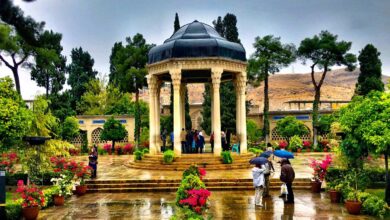
Located in northern Shiraz, Hafezieh is not a graveyard — it is a place of celebration. Eight columns support an open dome that looks like a dervish hat. People of all ages come at sunset, sit on the marble steps, read Hafez aloud, and take fal. On Yalda night (winter solstice) it stays open until dawn.
Saadiyeh (سعدیه) – Garden of Wisdom
Saadi’s tomb sits above an underground qanat with blue fish swimming in crystal water. The atmosphere is calmer, more contemplative. Students come here to study, lovers to whisper, and old people to remember.
Their Influence on Modern Iran and the World
- Every Iranian home has at least one copy of Divan-e Hafez beside the Quran.
- On Nowruz, families open Hafez for fal to see what the new year will bring.
- The greatest Iranian classical singers (Shajarian, Nazeri, Alizadeh) have devoted their lives to setting Hafez and Saadi to music.
- Goethe was so obsessed with Hafez that he wrote an entire collection called West-östlicher Divan (West-Eastern Divan) in response.
- Ralph Waldo Emerson called Hafez “the prince of Persian poets.”
- Barack Obama quoted Saadi in his 2009 Nowruz message to Iran.
- The Beatles, Led Zeppelin, and Madonna have all sampled Persian poetry inspired by these two.
Famous Quotes You Can Use Every Day
Saadi:
- “Have patience — all things are difficult before they become easy.”
- “The rose that lives for a day tells the autumn tulip: I was once like you.”
- “Whoever sows the wind will reap the storm.”
Hafez:
- “Even after all this time, the sun never says to the earth, ‘You owe me.’ Look what happens with a love like that — it lights the whole sky.”
- “The heart is a secret garden; only the beloved has the key.”
- “Plant the tree of friendship; it will bear the fruit of love.”
Frequently Asked Questions About Hafez and Saadi
Q: Which one should I read first — Hafez or Saadi? A: Start with Saadi (especially Gulistan). His language is clearer and his stories are easier for beginners. After you fall in love with Persian wisdom, move to Hafez — he will break your heart open.
Q: Can non-Persians truly understand Hafez? A: Yes, but you need a good translation with commentary. The best English versions are by Dick Davis, Gertrude Bell, or the modern one by Reza Ordoubadian and Enayat Sami.
Q: Is it true that Hafez predicted the future? A: Millions of Iranians believe so. Fal-e Hafez has an astonishing reputation for giving accurate life advice. Try it yourself online or with a physical book — the results are often uncanny.
Q: Are Hafez and Saadi considered religious or secular poets? A: Both. Saadi is more openly moral and Islamic. Hafez uses Islamic and Sufi imagery but constantly mocks religious hypocrisy, so hardline clerics have criticized him for centuries while ordinary people adore him.
Q: Can I visit their tombs as a tourist in 2025? A: Absolutely yes. Hafezieh and Saadiyeh are open every day from morning until late night. Entrance is very cheap (less than $2), and the gardens are among the most peaceful places on earth.
Q: Which modern Iranian city is most associated with them? A: Shiraz. It is still known as “the city of poets, roses, and nightingales.” April and May are the best months when all gardens are in full bloom.
Q: Do Iranians prefer Hafez or Saadi? A: It depends on mood. When they need wisdom and ethics → Saadi. When they need love, passion, and mystery → Hafez. Most say: “Saadi is our father, Hafez is our lover.”
Q: Is there an English movie or documentary about them? A: Yes. “Hafez: Tongue of the Hidden” (2007) and several BBC and Iranian documentaries. Also, the 2011 film “Saadi in Love” (Iranian production).
If you only remember one thing from this long journey through Persian literature: Saadi taught the world how to live with dignity. Hafez taught the world how to live with ecstasy.
Together, they taught Iran — and anyone who listens — how to be fully, beautifully, eternally human. ❤️🌹