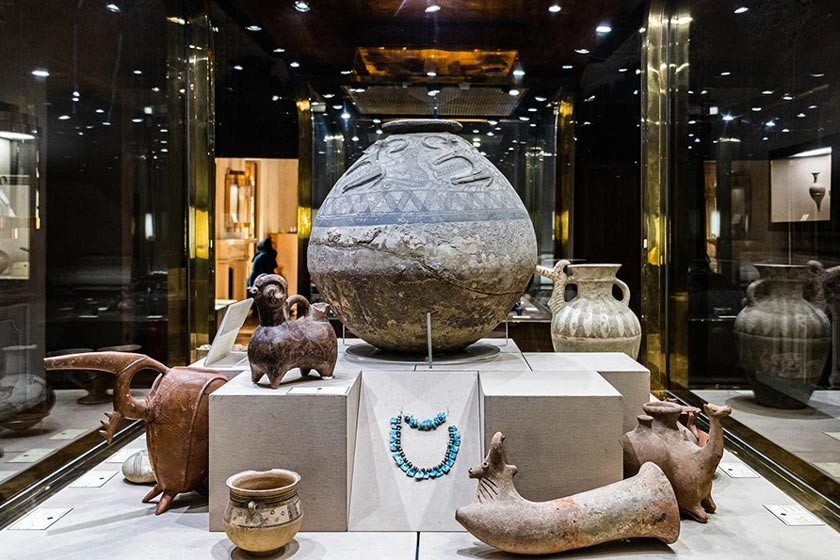

Embark on a cultural journey with Hamintour to the Glassware and Ceramic Museum of Iran, also known as the Abgineh Museum, located on Tehran’s iconic Si-e Tir Street. Nestled in a historic Qajar-era mansion, this museum showcases a stunning collection of glass and ceramic artifacts spanning millennia. Surrounded by landmarks like the National Park Sardar-e Bagh, the Museum of Science and Technology, and Petros Church, the Abgineh Museum offers a nostalgic ambiance perfect for leisurely strolls and cultural exploration. Join Hamintour to discover this Tehran gem, blending ancient artistry with modern elegance.
Abgineh Museum Overview
Built in 1291 AD under Ahmad Qawam’s directive, the Abgineh Museum was originally a grand Qajar mansion designed by Ostad Ali Mohammad Memarbashi as both a residence and office. Qawam lived there until 1330, after which it served as the Egyptian and Afghan embassies and a commercial bank. In the 1950s, Farah Pahlavi transformed it into a museum, with its official opening in 1355. Hamintour’s tours highlight its rich history, showcasing how this national treasure preserves Iran’s artistic legacy through meticulous restoration.
Museum Halls
The Abgineh Museum features six halls across two floors, each dedicated to distinct eras of Iranian glass and ceramic artistry. Designed by Austrian architect Hans Hollein, the museum’s modern showcases draw inspiration from Persepolis columns, Safavid arches, and the Zoroastrian Ka’aba, blending contemporary and traditional aesthetics. Hamintour guides you through these halls, where ancient artifacts meet elegant displays, creating a captivating cultural experience.
Oyster Hall
Named for its oyster-like design, this hall displays glass artifacts from the middle Islamic period and pottery from the 3rd and 4th centuries, sourced from Neyshabur.
Golden Hall
Showcasing gold dishes from the Seljuk period with intricate Naskh inscriptions, this hall highlights Iran’s medieval craftsmanship.
Crystal Hall
Featuring glass artifacts from the Achaemenid, Sassanid, and early Islamic eras (1st millennium BC), arranged chronologically to trace the evolution of glassmaking.
Lazord Hall
Known for its turquoise-glazed artworks from the 7th and 8th centuries, this hall reflects the patriarchal period’s artistic brilliance.
Book your Tehran adventure with Hamintour.
Museum Sections
Spanning two floors, the Abgineh Museum houses over 1,000 artifacts, from 4th-millennium BC clay vessels to 1st-millennium BC glassworks. Hamintour’s tours explore:
First Floor
The first-floor hallway showcases 1st-millennium clay pottery and 18th-19th century European glassworks. Key artifacts include ceramic wares, jars, zoomorphic vessels, and earthenware figurines. The Crystal Hall, Mina Hall, and an audiovisual hall enhance the experience with interactive displays.
Second Floor
The second floor features the Corridor, Oyster Hall, Zarin Fam, and Lazord Hall, displaying Islamic-era glass and pottery alongside contemporary works by modern Iranian artists.
Visitor Information
-
Address: Si-e Tir Street, Jomhouri Street, Tehran, Iran
-
Hours: Spring/Summer: 9:00 AM–7:00 PM; Autumn/Winter: 9:00 AM–4:30 PM
-
Phone: +98 21 66708153
-
Photography: Allowed
-
Smoking: Prohibited
-
Admission: Entry fee required
Hamintour’s guided tours ensure a seamless visit, with easy access from Tehran’s well-connected transport system, including taxis from Tehran International Airport.
View Abgineh Museum on Google Maps.
Conclusion
The Abgineh Museum, with Hamintour, is a must-visit for anyone exploring Tehran’s cultural landscape. Housed in a restored Qajar mansion, it showcases an extraordinary collection of glass and ceramic artifacts from the 2nd millennium BC to modern times, sourced from regions like Neyshabur, Kashan, and Rey. Its blend of historic charm and modern design, coupled with its prime location on Si-e Tir Street, makes it a cultural highlight. Book with Hamintour to experience this Tehran treasure and immerse yourself in Iran’s artistic heritage.
FAQs
What does the Abgineh Museum exhibit?
Over 1,000 glass and ceramic artifacts from the 4th millennium BC to contemporary times, showcased with Hamintour.
What is the museum’s architecture like?
A Qajar-era mansion with modern showcases inspired by Persepolis, Safavid arches, and Zoroastrian Ka’aba, explored with Hamintour.
Where is the Abgineh Museum located?
Si-e Tir Street, Jomhouri Street, Tehran, easily accessible via Hamintour’s tours.