


Breast Augmentation in Iran
What changes can an implant or fat transfer make? Which surgeon and operating facility should you trust? What will the whole trip cost, and who helps if recovery takes longer than planned? Start with those questions, not a package price.
Compare your optionsSee USD cost evidenceA clear starting point
Breast augmentation increases or restores breast volume with an implant or, for selected patients, transferred fat. It may address asymmetry, a small breast size or volume change after pregnancy or weight loss. It does not reliably lift markedly descended breast tissue; a lift may be a separate or combined operation. The American Society of Plastic Surgeons (ASPS) explains these distinctions.
Iran can be a practical option if you can identify a surgeon whose qualifications match the operation, confirm the actual surgical facility, obtain the device information and allow enough time for recovery and follow-up. The appeal of a lower public price is real for many travelers, but it does not answer those clinical questions. We focus on Tehran because it offers a range of plastic surgery consultations and hospital options. The final recommendation must come from a licensed surgeon after examination, not from a travel coordinator or photographs.
On this page
Implant, fat transfer or breast lift?
The word “augmentation” can hide several different choices. Ask the surgeon to describe the change in volume, shape and position separately. A larger implant cannot reliably solve substantial sagging; a lift changes position but does not create the same added volume as an implant. Combining procedures may be possible, but it also changes scars, operating time and risk. Our breast lift guide examines that decision in more detail.
| Approach | Usually discussed for | Main trade-off to examine |
|---|---|---|
| Silicone gel implant | A defined increase in volume and projection | Device-specific risks, possible future surgery, monitoring for silent rupture |
| Saline implant | Volume increase with a saline-filled device | Feel, visible rippling in some body types, deflation and replacement considerations |
| Fat transfer | Selected patients seeking a more modest change using their own tissue | Requires fat harvesting; some transferred fat may not survive; results vary |
| Lift with or without augmentation | Position and loose skin, sometimes with volume change | More extensive incisions and potentially different complication profile |
Implant discussions should go beyond brand and cup size. Ask for the manufacturer, exact model, fill, surface, dimensions, expected placement, serial-number record and the patient information for that device. “FDA approved” refers to specific devices and indications in the United States; it is not a blanket certification of a clinic in Iran. The FDA patient decision guidance is a useful checklist even when you are considering surgery elsewhere.
Incision location and whether the device is placed above or beneath chest muscle are individual choices. They affect visibility of a scar, tissue coverage, recovery and future imaging. Your surgeon should explain why a particular plan fits your anatomy and show what it cannot accomplish. Ask how the proposed size relates to your breast width and tissue quality rather than choosing an implant volume solely from a photograph.
Who might be a suitable candidate?
A consultation should cover your motivation, expectations, medical conditions and ability to follow the recovery plan. Pregnancy or breastfeeding, an active infection, unexplained breast symptoms, poorly controlled chronic disease, a history of blood clots, nicotine exposure or prior breast surgery can change the plan or call for postponement. A surgeon may request breast imaging based on your age, history and local clinical guidance. Do not stop prescribed medicines or supplements because of a website checklist; discuss each item with the treating team.
If your concern is pain, heavy breasts or skin irritation rather than lack of volume, breast reduction may be more relevant. If you already have implants and are considering a change, use the implant revision guide. These are different operations with different goals and quotes.
Bring to the consultation
A clear list of your goals, current medicines, allergies, previous operations, pregnancies, family or personal breast-health history, relevant imaging and your return-travel constraints. Ask how photographs or health records will be stored and who can access them.
Expect an honest answer
Sometimes the safest plan is to treat a health concern first, choose a smaller change, stage two operations or decide against surgery. You should be free to decline without pressure to buy a travel package.
How to choose a surgeon and operating facility
Start with the Iran Medical Council public directory. A direct profile can confirm the registration number and specialty shown at the time you check it. Then ask about experience with breast augmentation specifically, the hospital or day-surgery facility where the operation would take place, the anesthesiologist, emergency response and who sees you after discharge. A consultation office and an operating theater are not the same place.
| Tehran surgeon to investigate | Direct Medical Council record | Provider source | Still ask |
|---|---|---|---|
| Dr Arash Najaf Beygi | Registration 82925 | Breast implant information | Current operating facility, device and complete quote |
| Dr Alireza Ghaseminejad | Registration 63078 | Practice website | Procedure-specific cases and current hospital privileges |
| Dr Mohsen Fadaee | Registration 63822 | Published procedure gallery | Exact breast procedure, follow-up and revision terms |
These are unranked research leads, not endorsements or a claim of Hamintour partnership. The registry identifies plastic, reconstructive and burn surgery subspecialty for the named doctors; it does not publish their complication rates or establish that they will accept your case. Recheck each live profile before you commit.
For facility research, Ebnesina Hospital publishes a plastic surgery department that lists breast procedures, while Kasra Hospital publishes a plastic surgery specialist roster. Nikan Hospital publishes information for international patients. These pages provide a starting point; they do not independently prove that a particular surgeon operates there, that a current license covers your procedure or that a listed international service is included in your quote. Ask the chosen surgeon to identify the exact facility and request its current authorization and postoperative arrangements.
How much does breast augmentation in Iran cost?
A public USD example is available from Mehr Hospital in Mashhad: its international-patient comparison lists “breast implants” at about $2,000. The hospital labels its comparison as historical. It is not a Tehran market median, a Hamintour package price or a promise that the same amount would buy your proposed device and surgical plan. We do not have a verified set of current patient quotations from which to calculate a responsible median or typical range.
| Cost line | Public USD evidence | What your written estimate must clarify |
|---|---|---|
| Breast implant procedure | Approx. $2,000 historical hospital example | Surgeon, facility, anesthesia, device brand/model, tests and follow-up |
| Lift added to augmentation | No comparable verified public figure used here | Additional incisions, operating time, wound care and extra nights |
| Fat-transfer augmentation | No comparable verified public figure used here | Liposuction sites, anesthesia, number of stages and follow-up |
| Travel and recovery | Case-specific | Flight, visa, hotel, companion, transport, interpreter and contingency fund |
All displayed prices are approximate reference information, not a current offer. Source: Mehr Hospital’s international-patient price page. The hospital is in Mashhad; Tehran fees and included services may differ. Ask Hamintour Medical to help obtain a current, itemized USD quotation after a licensed surgeon reviews your case.
Compare totals, not a headline number. A proper quote should specify the operating facility, surgeon and anesthesiologist fees, implant manufacturer and model, lab tests, medicines, bra or other supplies, planned follow-up, hotel and transfers if bundled, payment and cancellation terms, and what is excluded if you need treatment for a complication. An implant may need future imaging or another operation years later; plan for those costs in your home country too.
Request a case-specific estimate
Share your goals and country of residence, then ask for the named surgeon, proposed procedure and an itemized price. A preliminary response is a starting point; the treatment decision follows a direct medical consultation.
Request Your Free Consultation
Get a personalized treatment plan from our elite medical experts.
What happens from the first enquiry to surgery?
- Initial review. Explain your goals and relevant history. Hamintour may help send records securely to an appropriate specialist. Photographs alone cannot replace a physical examination or establish implant size.
- Clinical consultation. Speak with the proposed surgeon about implant versus fat transfer, whether a lift is needed, expected scars, device details, alternatives and risks. Ask for a written plan in a language you understand.
- Travel and entry check. Confirm official entry requirements for your nationality and check your government’s current travel advice. Keep travel bookings flexible until the surgeon and facility confirm a feasible plan.
- In-person assessment. After arrival, the surgeon examines you and may change or decline the proposed plan. Any tests, imaging and anesthesia review should be ordered by the clinical team. You must have time to read consent information before surgery.
- Operation and immediate care. The treating surgeon and anesthesia team perform the operation at the named facility. Discharge depends on your condition and the facility’s assessment, not a package schedule.
- Follow-up and travel clearance. Agree on wound checks, device documentation, emergency contact and follow-up after you return home. The surgeon determines when flying is appropriate.
If you want a broader overview of related operations, the plastic surgery in Iran guide explains the differences between breast procedures, body contouring and reconstructive surgery.
Recovery is part of the trip, not an afterthought
Expect swelling, discomfort and temporary limits on arm movement, lifting and exercise. The exact care instructions depend on implant placement, whether a lift or another operation was combined, your health and the surgeon’s technique. Ask which symptoms are expected, which need a same-day call and which require urgent local care. A supportive bra, wound care and follow-up schedule should come from the treating team.
While in Iran
Allow time for at least one postoperative assessment and for a change of plan if recovery is slower. Choose accommodation that makes resting and returning to the surgeon practical. Arrange help with luggage and transport. Sightseeing should be optional and only after clinical approval.
After returning home
Keep your operative report, discharge summary, device card with serial numbers, medication list and direct contact details for the surgeon. Identify a clinician at home who can assess a concern. Remote messages cannot treat an infection, clot or wound problem.
The CDC medical tourism guidance warns that flying after surgery can raise blood-clot risk, particularly with major chest operations. Do not book a fixed flight on the assumption that everyone is cleared after the same number of days. Discuss your route, length of flight and individual risk with the surgeon. Seek urgent care locally for chest pain, breathing difficulty, a suddenly swollen leg, severe bleeding, rapidly worsening redness or fever with wound symptoms.
Risks, implants and long-term breast health
Every operation involves risk from anesthesia and surgery, including infection, bleeding, wound-healing problems, persistent pain, asymmetry, altered sensation and an appearance different from what you hoped. Implants add device-specific issues such as capsular contracture, rupture, rippling, displacement and the possibility of future removal or replacement. Breast implants are not lifetime devices. The FDA risk summary also discusses breast implant-associated anaplastic large cell lymphoma, which has been associated more often with textured implants, and reports of other rare capsule-associated cancers. Ask which exact device is proposed and why.
Silicone gel implant rupture can be silent. Follow the monitoring instructions for your device and the treating clinician’s advice; ultrasound or MRI may be used to investigate or screen for rupture. Keep the device card even if you move countries. Routine breast-health screening remains important, and you should tell the imaging team you have implants so they can plan appropriate views.
Discuss possible effects on breastfeeding and nipple sensation before deciding, especially if you hope to have children. Pregnancy, weight changes and aging can alter the result later. No responsible surgeon can promise a particular cup size, permanent symmetry or freedom from future surgery. If an implant already causes pain, swelling or a new lump, seek medical evaluation rather than relying on a cosmetic quote; our implant revision page discusses the separate decision about removal or exchange.
Breast augmentation before and after: a sourced example
Photographs are useful for discussing shape, symmetry and scar placement, but they cannot predict your result. Starting anatomy, implant type and size, any concurrent lift, camera angle and time after surgery all matter. Ask the treating surgeon for unedited views of patients with a similar starting point, the exact procedure performed and the follow-up interval.
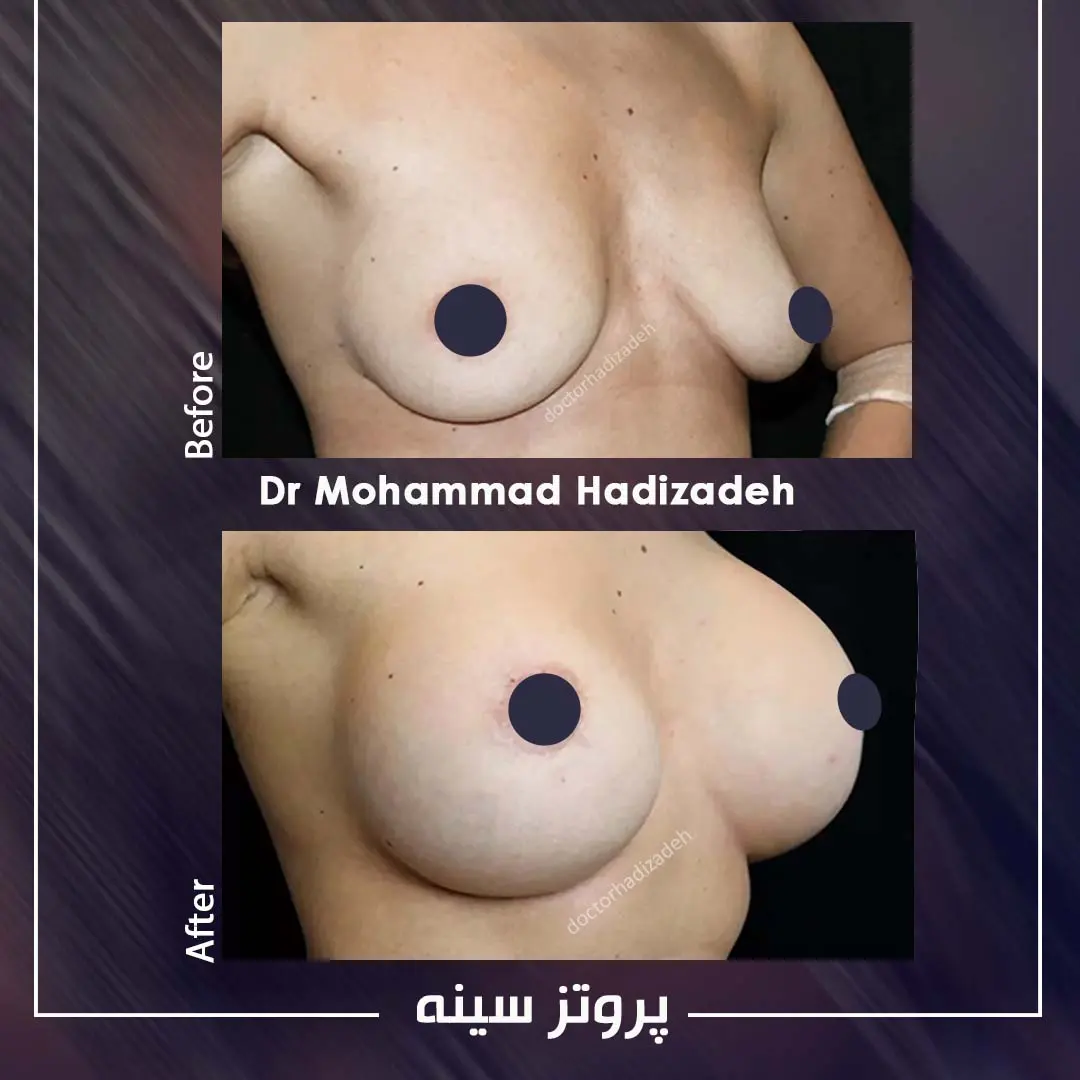
This is one published example, not a representative result or a Hamintour patient claim. The photographs appear in full within the page; no image is cropped to imply a different result.
More provider examples
See Dr Hadizadeh’s original account for more of his published material. Dr Sina Ghiasi’s gallery includes a separate lift-and-implant category; do not compare a combined operation with augmentation alone.
Other breast procedures
View Hamintour’s breast lift and breast reduction collections only for those procedures; their results should not be treated as implant-only outcomes.
How to use a gallery
Request the original full-size images, procedure details, postoperative timing and surgeon identity. Check whether the patient consented to public use. For broader visual references, see Hamintour’s before-and-after collection.
No before-and-after photograph establishes an expected outcome, a success rate or a guarantee. The decision to proceed belongs with a licensed surgeon and treatment facility after an individual assessment.
About Hamintour Medical
Hamintour Medical Tourism is an Iran-based platform that helps international patients compare options and coordinate a medical trip. We can connect you with doctors, clinics and hospitals and help organize practical steps from planning through return-home communication. We are not a hospital, clinic or medical practice, and we do not have a dedicated treating medical team. We do not diagnose, prescribe an implant or perform surgery.
Our role is to help you ask better questions, obtain a specialist assessment, compare what is and is not included in quotations, and keep the travel plan aligned with the treating team’s instructions. We cannot promise a result or substitute for a licensed clinician. Explore the Hamintour Medical homepage or the medical travel magazine for related guides.
What Hamintour Medical can coordinate
Depending on your request, we may arrange contact with a surgeon, an initial review of records by the appropriate specialist, a consultation appointment, an itemized quotation, flights or accommodation if requested, airport pickup, local transfers, language assistance and communication during your stay. We can also help reconnect you with the treating team after you go home. Tests and imaging are performed only when a doctor orders them. Leisure plans must fit the surgeon’s recovery advice.
To start, tell us whether you are considering implants, fat transfer or a lift as well; your country of residence; and the decision you are trying to make. We can help organize the next conversation without asking you to commit to surgery. You can also message Hamintour Medical on WhatsApp.
Frequently asked questions
Is breast augmentation the same as a breast lift?
No. Augmentation adds volume with an implant or transferred fat; a lift reshapes and raises existing tissue. Some people need both, while others need only one or neither. A surgeon must examine the tissue and explain the scar and risk trade-offs.
Will a breast implant last forever?
No implant is a lifetime device. Some people keep implants for many years, while others need earlier surgery for rupture, contracture, infection, a change in preference or another reason. Ask about surveillance, records and possible future costs.
Does an FDA-approved device mean my surgery in Iran is FDA approved?
No. FDA decisions concern specific devices and uses in the United States; they do not certify an Iranian surgeon, hospital or treatment package. Request the proposed device’s exact model, documentation and applicable local authorization.
Can I choose a size from a photograph?
Photographs help explain your goals but cannot determine implant dimensions or predict a result. The surgeon needs an examination, breast measurements, discussion of tissue coverage and an explanation of what is realistic for your body.
How many days should I stay before flying?
There is no safe universal number. The operation, anesthesia, wound condition and clot risk all matter. Keep flights flexible and leave only after a postoperative examination and explicit travel advice from the treating surgeon.
Can I breastfeed after implants?
Some people can, but ability to breastfeed cannot be guaranteed. The incision, surgical approach, prior anatomy and other factors matter. Raise future pregnancy and feeding plans at the consultation before choosing a technique.
Why is the published $2,000 price not my quote?
It is a historical public example from one hospital in Mashhad. Your procedure may use a different device, surgeon, facility or combined operation, and travel costs may be separate. Ask for a current itemized USD estimate after clinical review.
What if a problem appears after I return home?
Seek urgent local medical care for emergency symptoms. Keep your operation and device records, identify a clinician at home, and ask the Iranian treating team for a written follow-up pathway. Hamintour can help restore communication but cannot provide emergency treatment.