
doctors clinics
Egg and Ovarian Cortex Freezing in Iran
The Rise of Fertility Preservation in Iran Fertility preservation has become a cornerstone of modern reproductive medicine, offering hope to women facing medical treatments, such
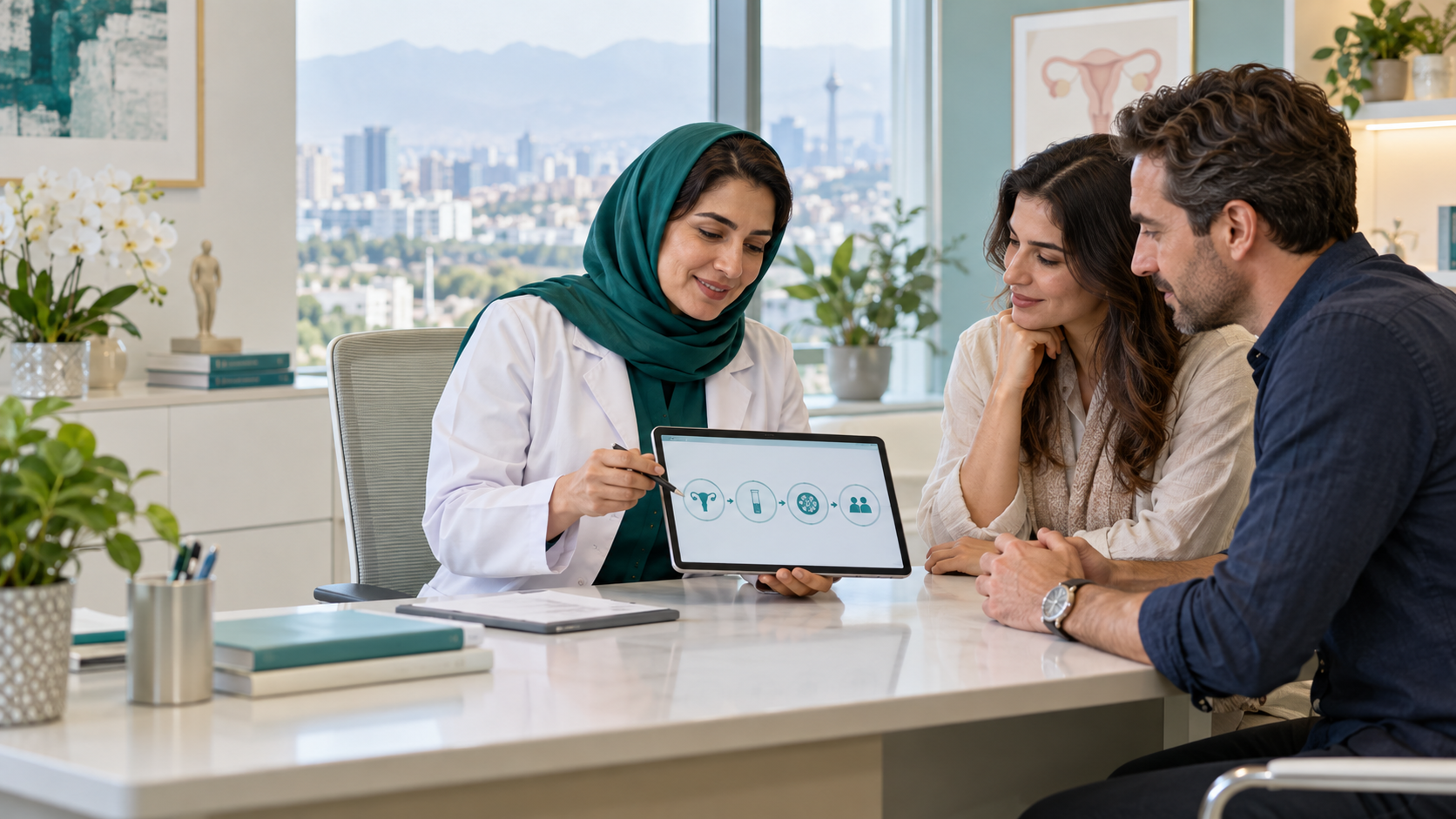
A practical guide for international patients comparing fertility evaluation, IVF, ICSI, IUI, fertility preservation and reproductive surgery in Iran—with transparent USD price observations, verified providers and realistic limits.
Travelling for fertility care is more complicated than booking a single procedure. A useful plan must connect diagnosis, ovarian or sperm factors, laboratory work, medication, timing, legal eligibility, embryo decisions, pregnancy follow-up and the possibility that more than one cycle may be needed. This page is designed to help you ask the questions that promotional pages often leave unanswered.
Tehran has dedicated fertility institutes, university-linked centers and private women’s hospitals with reproductive endocrinology, andrology, embryology, genetics, imaging and surgery pathways. The concentration can help when both partners require coordinated assessment.
Published international-patient offers are often lower than self-pay packages advertised in the United States and parts of Europe. Price alone does not show laboratory quality, suitability or the chance of live birth. Compare identical inclusions and exclusions.
Monitoring dates may change, medication response is unpredictable, transfer may be postponed and pregnancy follow-up continues at home. Flexible travel, a local doctor and clear embryo-storage instructions are essential.
The World Health Organization defines infertility as failure to achieve pregnancy after 12 months or more of regular unprotected intercourse and emphasizes that male, female or unexplained factors may be involved. Iran may be reasonable when the relevant center accepts the patient, both partners are evaluated where applicable, the proposed treatment is lawful and clinically appropriate, and reliable follow-up can be arranged.
The American Society for Reproductive Medicine recommends evaluation after 12 months when the female partner is younger than 35, after 6 months at 35 or older, and more promptly over 40. Evaluation should start without delay when there are irregular cycles, suspected uterine or tubal disease, endometriosis, known male-factor concerns, sexual dysfunction or a history that may reduce ovarian reserve. The timing must be personalized.
Testing should answer a clinical question. ASRM notes that ovarian-reserve tests support counselling but should not replace age and diagnosis, and that advanced sperm tests, thrombophilia panels, immunologic tests, endometrial biopsy or laparoscopy are not routine for every patient. Ask why each test is needed, how its result would change treatment and whether it must be repeated in Iran.
| Pathway | What it involves | May be considered for | Questions before choosing |
|---|---|---|---|
| Ovulation induction | Oral or injectable medicine with monitoring to encourage ovulation | Selected ovulatory disorders after other factors are assessed | Monitoring schedule, cycle-cancellation rules, multiple-pregnancy and OHSS risk |
| IUI | Prepared sperm placed in the uterus near ovulation, sometimes with stimulation | Selected cervical, ovulatory, unexplained or mild male-factor cases | Tubal patency, total motile sperm, medication, number of attempts and cancellation policy |
| IVF | Ovarian stimulation, egg retrieval, laboratory fertilization, embryo culture and transfer or freezing | Tubal disease, endometriosis, failed simpler treatment, age-related urgency or other indications | Protocol, medication, lab methods, transfer policy, freezing, storage and outcome denominator |
| ICSI | A single sperm is injected into an egg as part of an IVF laboratory cycle | Important male factor, surgically retrieved sperm or selected prior fertilization problems | Why ICSI is recommended, whether it is included, and what happens if no mature egg or usable sperm is available |
| Frozen embryo transfer | A frozen embryo is thawed and transferred in a prepared or natural cycle | Freeze-all strategy, later transfer or use of stored embryos | Embryo location, consent, thaw survival, preparation medicines and storage fees |
| Fertility preservation | Freezing eggs, sperm, embryos or selected reproductive tissue | Before gonadotoxic treatment, delayed parenthood or selected medical circumstances | Realistic future use, collection cost, storage contract, export rules and decisions after death or separation |
| Reproductive surgery | Hysteroscopy, laparoscopy, fibroid or endometriosis surgery, tubal or male reproductive surgery in selected cases | Anatomic problems that may affect fertility or symptoms | Evidence that surgery improves the specific goal, alternatives, recovery and effect on ovarian reserve |
| PGT | Embryo biopsy with genetic analysis before transfer | Selected monogenic disease, structural chromosome rearrangement or other defined indications | Exact test, lab location, limitations, inconclusive results, mosaic findings and confirmatory prenatal testing |
The American College of Obstetricians and Gynecologists explains that treatment may include lifestyle measures, medicine, surgery, IUI or assisted reproductive technology. IVF does not guarantee fertilization, embryo development, implantation, ongoing pregnancy or live birth. ICSI is a laboratory technique within IVF; it is not a separate guarantee of success.
Standard IVF using the intended parents’ own eggs and sperm is different from treatment involving donated eggs, sperm, embryos or a gestational carrier. Do not treat general statements about what is “legal in Iran” as confirmation that a specific foreign patient can receive a specific service.
A peer-reviewed review of Iran’s embryo-donation law describes specific recipient conditions and significant unresolved legal questions. It reports that the statutory route concerns legally married couples and includes a citizenship condition for recipients. More recent research on donation practice in Iran also identifies gaps and the need for clearer national protocols. These sources are reasons to verify, not instructions for an individual case.
The figures below summarize public English-language offers aimed at international patients. They are planning observations, not hospital tariffs or guaranteed Hamintour prices. Packages use different definitions, so the count and entry-point median do not make unlike offers clinically equivalent.
Observed entry-point median: $1,950
Advertised span: about $1,500–$6,000+
Higher figures may include more medication, tests, transfer, travel or coordination; some low figures are limited procedure prices.
Observed span: about $300–$800
Median: not treated as reliable because only two usable listings were found.
Medication, monitoring, sperm preparation and repeat attempts may be separate.
Observed examples: $100 per straw for six months and $150 for a one-year extension.
Collection, freezing, infectious screening and future transfer are separate unless written into the package.
| Item | Approximate international-patient planning figure | Often excluded or variable |
|---|---|---|
| Initial consultation and basic review | Ask for a case-specific quote | Repeat ultrasound, hormone tests, semen analysis, infectious screening and translation |
| IUI cycle | $300–$800 in the small public sample | Stimulation drugs, monitoring, cancellation and repeat cycles |
| IVF / ICSI cycle | $1,500–$6,000+ across advertised offers | Medication, ICSI, anesthesia, freezing, transfer, PGT and complications |
| Egg-donation IVF example | One public provider listed $2,000 procedure-only and $3,200 as a package | Eligibility, donor-related costs, medicine, legal work, storage and travel |
| Genetic testing / PGT | Itemized quote required | Biopsy, number of embryos, external laboratory, shipping and confirmatory testing |
| Frozen embryo transfer | Itemized quote required | Preparation medicine, monitoring, thawing and storage balance |
Price-source names: HayatMedTour, Pars Med Travel, Heritage Persia, Medtourtoiran, Iran Health Agency, AriaMedTour and Pooyesh Fertility Clinic. Prices are approximate, can change and may represent non-equivalent packages. For an exact figure, request an itemized written quotation through Hamintour Medical after records are reviewed.
| Market | Publicly advertised self-pay context | Comparison limitation |
|---|---|---|
| Iran | About $1,500–$6,000+ in reviewed international offers | Package definitions vary widely |
| Turkey | About $3,000–$6,000 in one medical-travel comparison | Medication and genetic testing may be separate |
| Europe | About $5,000–$9,000 in one broad comparison; country rules differ | Private versus subsidized care is not equivalent |
| United States | About $12,000–$25,000 in broad self-pay comparisons | Medication, insurance and clinic packages vary greatly |
Comparison-source names: Heritage Persia and published international fertility-travel reporting. These are approximate advertised prices, not matched quotations. They do not prove quality or value and should not be used without checking the same clinical scope.
Get a personalized treatment plan from our elite medical experts.
A clinic can report a high percentage while using a favorable denominator or selecting lower-risk patients. The US CDC guide to ART success rates distinguishes outcomes per intended retrieval, actual retrieval and embryo transfer. The UK fertility regulator explains that clinic rates are hard to compare because patient age, diagnosis and case mix differ.
| Ask the clinic for | Why it matters | Red flag |
|---|---|---|
| Live birth, not only positive test or clinical pregnancy | Live birth is a later and more meaningful outcome | “Success” is undefined |
| Outcome per cycle started or intended retrieval | Includes cancellations before retrieval or transfer | Only transfer-stage results are shown |
| Own eggs separated from donor eggs | Egg source and age strongly affect interpretation | All cycles are combined |
| Age bands and diagnosis | A single clinic-wide number cannot predict an individual result | One rate is promised to everyone |
| Multiple-birth rate and embryo-transfer policy | Pregnancy count should not outweigh maternal and newborn safety | Twins are marketed as a benefit |
| Number of cycles and collection period | Small samples can fluctuate dramatically | No sample size or period is supplied |
Ask for the exact numerator, denominator, age group, egg source, cycle period and whether the result is audited. No verified national Iranian dataset comparable to CDC or HFEA clinic reporting was identified for this page. Hamintour therefore does not reproduce promotional success percentages from directories or clinic marketing.
This is a research shortlist, not a ranking or endorsement. Availability, licensing scope, laboratory practice, international-patient eligibility and named-doctor schedules must be reconfirmed directly.
| Center | Setting | Publicly verifiable pathway | International route | Public USD tariff | Best comparison use |
|---|---|---|---|---|---|
| Royan Infertility Treatment Center | Dedicated clinical and research center, Tehran | Female infertility, male infertility, laboratories, surgery and preservation sections published | International-patient unit published | Not used as a complete tariff | Multidisciplinary fertility and andrology comparison |
| Avicenna Infertility Clinic | Specialist infertility and recurrent-loss center, Tehran | Clinic and research-institute pathway published | Confirm current foreign-patient process | No complete comparable tariff found | Infertility, recurrent loss and reproductive biotechnology pathway |
| Sarem Hospital | Private specialist women’s hospital, West Tehran | IVF, ICSI, IUI, preservation and related women’s services published | Hospital IPD published | Request current itemized quote | Hospital-based fertility care with obstetric support |
| MOM Fertility Center | Dedicated private fertility center, Tehran | Fertility services and specialist-team sections published | Multilingual website; confirm current foreign-patient pathway | No complete comparable tariff found | Private dedicated-center comparison |
| Erfan Hospital fertility and genetics department | Private multispecialty hospital, West Tehran | IVF, ICSI, IUI and genetic services published by the hospital | Official hospital IPD published | Request current itemized quote | Hospital support where other specialties may be needed |
The official Royan fertility-center website publishes clinical sections, laboratories, surgery, preservation information and named specialist rosters. Its international-patient section provides a route for foreign-patient inquiries. Verify the exact consultant, protocol, laboratory services, waiting time and package before choosing.
The official Avicenna Clinic website is the direct starting point for current services and contact. Because websites and rosters can change, request the current named reproductive specialist, embryology scope, recurrent-loss pathway and foreign-patient admission process in writing.
The official Sarem IVF page lists IVF, ICSI, IUI, genetic testing and preservation services. Its international-patient department supports hospital-based planning. Provider-published claims require independent comparison and case-specific confirmation.
Use the center’s official website and official specialist-team section to check current services, team and contact information. Do not rely on an undifferentiated “success rate”; request age-specific live-birth definitions and sample size.
The hospital’s official genetics and infertility page lists ICSI, IUI and genetic services, while its official IPD page provides the international-patient route. Confirm the current team and laboratory pathway directly.
For a longer center comparison, read Hamintour’s guide to a fertility center in Tehran. The article should be used together with direct provider verification, not as a substitute for medical review.
The doctors below appear on provider rosters or provider pages reviewed for this guide. Registration confirms identity and recorded qualifications; it does not prove outcomes, current availability or privileges. Every name links directly to the individual Iran Medical Council profile and separately to the provider source.
| Doctor | Registry qualification | Medical Council number | Direct official registration | Provider evidence |
|---|---|---|---|---|
| Dr. Mahnaz Ashrafi | Female infertility fellowship; obstetrics and gynecology | 22951 | Individual council profile | Royan specialist roster |
| Dr. Maryam Hafezi | Female infertility fellowship; obstetrics and gynecology | 67848 | Individual council profile | Royan specialist roster |
| Dr. Firoozeh Ghaffari | Infertility fellowship; obstetrics and gynecology | 43890 | Individual council profile | Royan specialist roster |
| Dr. Mohammad Ali Sadeghi Gilani | Urology specialist | 24306 | Individual council profile | Royan male-infertility roster |
| Dr. Hesamoddin Sajadi | Andrology fellowship; urology | 107949 | Individual council profile | Royan male-infertility roster |
| Dr. Abotaleb Saremi | IVF fellowship; obstetrics and gynecology | 12335 | Individual council profile | Sarem official IVF page |
| Dr. Ashraf Moini | Female infertility fellowship; obstetrics and gynecology | 23198 | Individual council profile | Royan specialist roster |
Transliteration can vary. Match the English name to the Persian name and Medical Council number before booking. Confirm who will perform retrieval, transfer or surgery; a center founder or listed consultant may not personally conduct every stage.
Send the full fertility history for both partners, not only the most recent test. The center should identify missing investigations, confirm whether it can assess the case and explain that the plan may change after examination.
Some baseline tests or early monitoring may be completed at home if the Iranian specialist accepts the laboratory and ultrasound format. Decide which doctor controls medication changes and how urgent results will be communicated across time zones.
After arrival, repeat examination or tests may change the schedule. Confirm consent, medicine names, exact laboratory techniques, number of embryos planned for transfer, freezing decisions and emergency contact before treatment proceeds.
Monitoring guides dose changes and the timing of the trigger and egg retrieval. Not every follicle yields an egg; not every egg is mature or fertilizes; not every embryo reaches transfer or freezing. Ask when and how the embryology team reports each stage.
A fresh transfer may not be advisable in every cycle. Risk of ovarian hyperstimulation, hormone findings, uterine factors, PGT or scheduling may lead to freezing embryos for later transfer. The clinical team should explain the reason and additional cost.
Obtain an English cycle summary, medication plan, embryo report, storage contract, emergency signs and pregnancy-test date. If pregnant, arrange early obstetric care at home. If unsuccessful, request a structured review rather than an automatic repeat of the same plan.
| Issue | What patients should understand | Planning question |
|---|---|---|
| Ovarian hyperstimulation syndrome | Stimulation can cause enlarged ovaries and fluid shifts; severe cases can require hospital care | How is risk assessed, monitored and managed after I leave Iran? |
| Multiple pregnancy | Transferring more than one embryo can increase maternal and newborn risk | What is the center’s single-embryo transfer policy for my case? |
| Egg retrieval and anesthesia | Bleeding, infection, injury and anesthesia complications are uncommon but material | Which licensed facility provides retrieval and emergency support? |
| Ectopic pregnancy and miscarriage | IVF does not eliminate either risk | Who reviews early blood tests and ultrasound after I return? |
| No embryo to transfer | A cycle may stop at stimulation, retrieval, fertilization or embryo development | What fees remain payable and how is the cycle reviewed? |
| Cryostorage | Consent, fees, identification, equipment and long-term decisions matter | What happens after nonpayment, separation, death or a request to export? |
| Emotional strain | Uncertainty, repeated appointments and loss can affect both partners | Is counselling available in a language I understand? |
ACOG notes that ovarian stimulation can cause multiple pregnancy and ovarian hyperstimulation syndrome and that IVF may require more than one cycle. Ask for written instructions describing urgent symptoms, the hospital to attend in Tehran and the clinician who will communicate with your home doctor.
Outcome images are not included on this page. Fertility treatment does not have a medically meaningful “before and after” photograph. Ethical evidence focuses on diagnosis, laboratory records, embryo documentation, pregnancy follow-up and live-birth outcomes with clearly defined denominators.
Include laboratory dates, reference ranges and measurement units. Ask how sensitive health data will be transferred and stored. Do not send irreplaceable originals by post. A short summary in English helps, but it should accompany rather than replace source reports.
Check the official Iranian e-visa portal before purchasing tickets. Nationality, passport details and purpose of travel can affect the process. Hamintour can help coordinate supporting documents but cannot guarantee approval or border entry.
Read the travel advisory issued by your own government immediately before booking and departure. One official reference is the UK FCDO Iran travel advice. Use the advisory relevant to your citizenship and personal circumstances.
Standard travel insurance may exclude planned fertility care, pregnancy, medication complications or extended stays. Obtain written clarification about emergency hospitalization, pregnancy-related care, cancellation, companion costs and medical evacuation.
Confirm the currency, deposit, accepted payment method, refund rule and who authorizes added costs. International cards may not function normally in Iran. Carry a written financial plan and request receipts for clinical and travel services.
Keep hotel arrangements flexible and close enough for repeated monitoring. Plan transport that does not depend on navigating alone immediately after sedation. If a companion cannot travel, confirm whether the center requires an adult escort after egg retrieval.
Hamintour supports the practical journey while the licensed fertility team remains responsible for diagnosis, treatment, consent, laboratory decisions and clinical follow-up.
Explore the Hamintour Medical home page, browse the Iran medical travel magazine, read the IVF treatment guide, review the IVF travel guide, learn about embryo donation questions and read the separate surrogacy overview. Legal and clinical eligibility must still be confirmed for the individual patient.
Hamintour Medical Tourism helps international patients identify relevant options and communicate with doctors, fertility centers, clinics and hospitals in Iran. Its role can include introductions, appointment scheduling, record transfer, quotation coordination, accommodation, transport, language support and follow-up communication.
Hamintour is not a hospital, fertility clinic, laboratory or medical practice. It does not diagnose infertility, prescribe stimulation medicine, select embryos, provide legal opinions or guarantee pregnancy. The treating doctor, embryology laboratory and licensed facility make clinical decisions after assessment and informed consent.
Public international-patient offers reviewed for this guide range from about $1,500 for a limited entry package to $6,000 or more for broader IVF or ICSI packages. The observed entry-point median was approximately $1,950. Medication, ICSI, embryo freezing, transfer, genetic testing, donor arrangements, repeat monitoring and travel may be separate. Request a written, itemized quote after medical review.
No. Hamintour organizes records, provider options, appointments, quotations and travel support. A licensed fertility specialist and the treatment center must evaluate both partners where applicable and decide whether timed treatment, ovulation induction, IUI, IVF, ICSI, surgery, fertility preservation or another pathway is appropriate.
A stimulated IVF cycle usually requires repeated monitoring over several weeks, but the exact schedule depends on the protocol, ovarian response and whether transfer is fresh or frozen. Some monitoring may be completed at home if both medical teams agree. Do not buy inflexible flights until the center provides a personalized calendar.
A positive blood test is an early milestone, not the same as an ongoing pregnancy or live birth. Ask clinics to define every outcome they quote, including whether it is measured per cycle started, egg retrieval, embryo transfer, clinical pregnancy or live birth.
Sometimes, but no clinic can promise this. Age, diagnosis, ovarian response, sperm factors, embryo development and chance all affect the result. A responsible plan should explain what happens if no egg is retrieved, no embryo develops, transfer is cancelled or the first cycle does not lead to a live birth.
Do not assume eligibility. Iranian embryo-donation law contains specific conditions, and published legal reviews identify unresolved areas around other third-party reproduction. Citizenship, marital documentation, religious or legal requirements, parentage and exit documents can matter. Obtain written confirmation from the licensed center and independent legal advice before paying or travelling.
Preimplantation genetic testing may be medically indicated for some inherited conditions. Requests for non-medical sex selection raise ethical, clinical and center-policy questions. Availability should never be assumed, and testing cannot guarantee pregnancy or the birth of a healthy child.
Send both partners' identification details, ages, fertility history, pregnancy and miscarriage history, prior cycle summaries, ultrasound and tubal-test reports, hormone and ovarian-reserve results, semen analyses, genetic reports, medical conditions, operations, allergies and medicines. Remove information you do not wish to share until a secure route is agreed.
Compare licensing, named clinicians, laboratory and cryostorage procedures, age-specific live-birth data with a defined denominator, multiple-birth policy, total package inclusions, counselling, emergency support and continuity after return. A single pregnancy percentage or testimonial is not enough.
Check the official Iranian e-visa portal and the current travel advisory issued by your own government before booking and again before departure. Hamintour may coordinate supporting documents but cannot guarantee a visa, entry or the security environment.
Provider pages support only what each provider publishes. They do not independently prove outcomes. Doctor registration, hospital privileges, laboratory practice, legal eligibility, treatment availability, price and international-patient admission must be reconfirmed. Public price observations are approximate and non-equivalent. The final treatment decision belongs to the licensed fertility specialist and center.
The Rise of Fertility Preservation in Iran Fertility preservation has become a cornerstone of modern reproductive medicine, offering hope to women facing medical treatments, such

Why Iran Excels in Embryo Donation Iran has solidified its position as a premier destination for fertility treatments, including embryo donation, due to its advanced

Why Iran is a Top Choice for IMSI Iran has established itself as a premier destination for advanced fertility treatments, including Intracytoplasmic Morphologically Selected Sperm

The Role of Microdissection TESE in Overcoming Male Infertility Microdissection TESE has revolutionized fertility treatment for men with non-obstructive azoospermia (NOA), where sperm production is

Introduction to PGD in Iran Preimplantation Genetic Diagnosis (PGD) is a specialized procedure used during in vitro fertilization (IVF) to identify specific genetic conditions in

Understanding Reproductive Surgery in Iran Reproductive surgery encompasses a range of procedures aimed at addressing anatomical or functional issues that impair fertility or reproductive health.

Surrogacy in Iran offers a beacon of hope for couples navigating infertility challenges, providing ethical, advanced, and compassionate pathways to parenthood. As a destination renowned

Struggling with infertility can be emotionally and financially challenging, but in-vitro fertilization (IVF) has brought hope to countless couples worldwide. Iran has positioned itself as
Intrauterine insemination (IUI) is a simple, cost-effective fertility treatment that offers hope to couples struggling with infertility. Iran, a regional leader in reproductive medicine, hosts

In-vitro maturation (IVM) offers hope to couples facing infertility, particularly those seeking a safer, more affordable alternative to in-vitro fertilization (IVF). Iran has emerged as

Ovulation induction (OI) is a vital fertility treatment for women facing irregular or absent ovulation, helping them produce mature eggs for natural conception or assisted

For couples or individuals facing infertility challenges, assisted reproductive technologies like egg and sperm donation offer a beacon of hope. In Iran, these procedures have