


A practical guide for international patients
Forehead Reduction Surgery in Iran
Hairline lowering can change the frame of a face, but the decision starts with a quieter question: is your hairline stable, and can your scalp move safely enough to make the change you want? This guide explains what the operation can and cannot do, how to compare Tehran surgeons, what to budget in US dollars, and how to plan a trip that allows time for review before you fly home.

- What hairline lowering changes
- Who may be suitable
- Surgery, transplant and brow lift
- Why consider Iran?
- Tehran provider evidence
- How to choose a surgeon
- How surgery is performed
- USD cost and quote checklist
- Ask for a personal quotation
- Travel and recovery plan
- Risks and warning signs
- Before-and-after cases
- About Hamintour Medical
- Frequently asked questions
What is forehead reduction surgery?
Forehead reduction, hairline lowering and scalp advancement usually describe an operation in which a surgeon moves the hair-bearing scalp forward toward a new hairline. The aim is to shorten the visible distance from the hairline to the brows. The operation changes the position of the existing hairline; it does not add new hair follicles or reshape the forehead bone. That distinction matters because the same phrase “forehead reduction” is sometimes used online for bony forehead contouring, a separate procedure with different indications and risks. Our forehead contouring guide addresses the bony operation.
In a systematic review of published hairline lowering studies, the pooled average advancement was around 1.6 cm. That is a description of selected study patients, not a prediction for an individual. Scalp mobility, the original hairline, the planned incision, prior surgery and the surgeon’s judgment all influence what can safely be achieved. Ask a prospective surgeon to measure your hairline in person and show the proposed line on your own photograph. A claim that everyone can lower it by a fixed number of centimetres should make you pause.
Hairline lowering may be considered by women or men with a high, stable hairline, including some people planning facial feminization. The design must reflect anatomy, hairstyle, goals and future hair-loss risk. The published surgical series illustrates why patient selection matters.
Who might be a reasonable candidate?
Potentially suitable
A high but stable frontal hairline, adequate scalp movement, reasonable expectations and an understanding that a permanent incision will be placed along the new hairline. Good general health and a workable aftercare plan are also important.
Needs extra assessment
Progressive thinning, patterned hair loss, previous scalp or forehead surgery, tight scalp, a history of poor scarring, active smoking, medication affecting bleeding or healing, and any planned procedure that shares the same incision.
May point elsewhere
If the concern is temple recession, sparse hair density or changing hair loss, a transplant or hair-loss assessment may be more relevant than moving the existing scalp. If the concern is low brows or expression lines, examine a brow lift separately.
None of these boxes is a remote diagnosis. A plastic surgeon or other appropriately qualified operating specialist must examine your scalp, hair density, skin, medical history and goals before recommending an operation. Bring clear photos of your hairline with hair pulled back, from front and both sides, but expect the final decision to depend on an in-person examination. If you are researching hair transplantation in Iran, the distinction between relocating existing scalp and implanting follicles is especially important.
Which approach matches your concern?
| Main concern | Procedure to discuss | What it changes | Main limitation |
|---|---|---|---|
| Naturally high, stable hairline with mobile scalp | Scalp advancement / hairline lowering | Moves the existing hair-bearing scalp forward | Limited by scalp laxity; a hairline scar remains and must heal |
| Temple gaps or sparse frontal density | Hair transplant | Adds follicles to selected areas and can reshape the outline | Depends on donor supply and later growth; it does not advance the entire scalp |
| Low brows or upper-face laxity | Brow or forehead lift | Repositions brow tissues | Does not automatically shorten a high forehead; some approaches may move the hairline up |
| Prominent brow bone or forehead shape | Bony forehead contouring | Changes underlying bone anatomy | A separate, potentially more complex operation; requires specific imaging and planning |
| Both a high hairline and another concern | Carefully planned combined or staged treatment | May address more than one problem | More surgery can mean more risk, recovery and cost; ask why it is necessary |
Read our separate guides to brow lift, eyebrow transplant, and forehead contouring. Those treatments solve different problems. A request for “a smaller forehead” is not enough to select one of them without an anatomical assessment.
Why consider Iran for hairline lowering?
Tehran has plastic surgeons who publicly describe scalp advancement and show examples from their own practices. An international patient can use those pages as a starting point for direct questions, and a coordinator can help arrange consultations, translation and a written quote. A lower advertised price may be attractive, but neither a polished gallery nor a tourism package proves surgical quality. The CDC’s medical tourism guidance recommends checking the clinician, the facility, the total cost, the follow-up arrangement and plans for complications before travelling.
Travel conditions can change quickly. Before paying for flights or surgery, check your own government’s current advice alongside the UK government’s Iran travel advice, and confirm entry requirements with an official Iranian diplomatic or consular source for your passport. An advisory describes risk and is not a medical judgement. Hamintour can help coordinate logistics, but you decide whether to travel after reviewing current official guidance and your own circumstances.
Tehran providers with procedure-specific public information
A useful shortlist should be smaller than a padded “top five” list. We could directly verify a dedicated hairline-lowering page and a matching professional registration for the two surgeons below. These entries are research leads, not a ranking, endorsement or statement that a consultation has confirmed they are taking international patients. Hospital privileges, operating facility and current availability still need to be checked with the provider.
| Surgeon and city | Procedure evidence | Professional registration | Still ask for |
|---|---|---|---|
| Dr Mehdi Ahmadi Tehran | Dedicated forehead-shortening explanation and provider-published cases | Iran Medical Council profile, registration 108819 | Named operating facility, proposed lowering, scar plan, co-procedure list, follow-up and written USD quote |
| Dr Mohsen Fadaei Tehran | Dedicated forehead-shortening explanation | Iran Medical Council profile, registration 63822 | Procedure-specific, labelled cases; exact operating site; anesthetist; scar follow-up |
We deliberately did not count other forehead lifts or bony contouring galleries as proof of experience in scalp advancement. We also did not use a provider’s unspecific facelift images as hairline-lowering examples. If you want a broader comparison, ask each potential provider for a named surgeon, direct registration link, procedure-specific cases and written facility details before adding that option to your shortlist. You can compare surgeons featured in our plastic surgeons and clinics guide, but confirm this exact operation with them.
How to choose the surgeon and facility
Do not let a dramatic result photograph replace a consultation. Ask the surgeon to examine your hairline for evidence of loss, test scalp mobility, draw a conservative proposed line and explain the visible scar when your hair is wet or tied back. Ask how they would revise the plan if they see early thinning at the temple or frontal edge. A surgeon should be able to explain why scalp advancement is preferable to hair transplantation for women or to no surgery in your case.
Identity and scope
Check the exact clinician on the Iran Medical Council search. Match the registration number and specialty to the doctor who will perform the operation. Do not assume a clinic brand identifies the operating surgeon.
Facility and safety
Ask for the name and address of the licensed operating facility, anesthesia arrangements, emergency transfer pathway and who examines you after surgery. Request written instructions and a contact number for problems outside normal office hours.
Evidence and consent
Ask for several labelled cases with the same procedure, similar hairline and comparable camera angles. Confirm whether other surgeries were performed in the same session and when the “after” photographs were taken.
What happens before, during and after surgery?
In a typical scalp-advancement operation, the surgeon marks an incision along the hairline, mobilizes hair-bearing scalp, moves it forward and closes it at the planned lower position. The detailed technique, anesthesia and whether another operation is combined with it are case-specific. Published reviews describe several approaches, so a generic page cannot specify exactly how your surgeon will operate. Ask what tissue will be removed, how tension is controlled, where the scar lies and whether the surgeon expects a later hair transplant to soften the line. The literature review is a useful starting point for discussing techniques and reported outcomes.
What should you budget in US dollars?
For planning only, public English-language Iran medical-travel listings have quoted roughly US$2,000–5,000 for forehead reduction or hairline lowering. The listings vary in what they include, and some are older. This is a broad advertised-price envelope, not a Hamintour transaction database, verified patient invoice, market median or current offer from either surgeon above. The figure may be unsuitable for combined surgery or a more complex case. Source names reviewed: Iranian Surgery, MitraMed Iran and AriaMedTour. We do not link to competing travel coordinators.
| Budget component | What to request in writing | Why it matters |
|---|---|---|
| Surgery and surgeon | Surgeon fee, exact procedure, any simultaneous operation, possible revision terms | A “forehead” quote may describe a brow lift or bony contouring instead |
| Facility and anesthesia | Operating room, anesthetist, recovery and admission charges | These may be billed separately from the surgeon |
| Before and after care | Tests, consultation, medicines, dressings, visits and English-language record | Extra visits can change both cost and length of stay |
| Travel and stay | Flights, accommodation, airport/local transport and translator if required | A surgery-only figure is not a full trip budget |
| Contingency | Complication pathway, extra nights, unexpected treatment and insurance limits | The cheapest initial quote can become the most expensive trip |
All prices are approximate. Ask Hamintour Medical for a current, itemized USD quotation based on your photographs and medical history, then have the treating surgeon and facility confirm it after assessment. Clarify deposit terms, payment method, refund conditions and who pays if the operation is postponed for medical reasons. Do not budget with a local-currency clinic price intended for domestic patients or assume exchange-rate savings will cover an unexpected complication.
Request an initial review and itemized plan
If you want to explore the procedure, share your age range, country of residence, relevant health conditions and clear front/side hairline photographs through the form. Tell us whether your hairline has changed over time and whether you have had scalp surgery or transplantation. Hamintour can route information to an appropriate provider for an initial opinion and coordinate a written proposal. A photograph review is preliminary; only the treating clinician can decide suitability and treatment after proper assessment.
Request Your Free Consultation
Get a personalized treatment plan from our elite medical experts.
Prefer to ask a question first? Message Hamintour Medical on WhatsApp. Please avoid sending sensitive medical records through an unprotected channel unless you are comfortable with its privacy terms.
Plan the trip around healing, not sightseeing
Before booking: obtain the surgeon’s proposed operation and facility name, ask your home clinician about any health conditions, and check the current travel advice and entry rules for your nationality.
Arrival and consultation: leave room in the schedule for an in-person examination, tests if needed, informed consent and a decision to cancel or alter the plan. Bring a list of medicines and allergies and copies of relevant medical records. If the new hairline drawn on your face does not match what you understood from remote messages, stop and discuss it before surgery. You should not feel compelled to proceed because flights and accommodation are already paid.
Early postoperative days: attend the surgeon’s scheduled checks and keep your calendar flexible. Ask in advance how the wound should be cleaned, when washing is allowed, who checks the incision, and what symptoms require urgent assessment. Normal tourism activities may be inappropriate while healing. The CDC warns that travel and surgery can compound risks and advises against delaying care for suspected complications. The treating surgeon must clear you to fly based on your own recovery; a webpage cannot set a safe departure day for everyone.
Risks, limitations and when to seek help
The main decision is not simply whether the forehead can be made shorter. It is whether the desired change is worth an incision at the hairline and the possibility of visible scarring, altered sensation, hair shedding near the incision, wound-healing problems, asymmetry, infection, bleeding or an unsatisfactory position. Published series and reviews report outcomes in selected patients; they do not eliminate these risks or guarantee a particular scar. Discuss any personal history of thick scars, poor healing or hair loss. Ask the surgeon to show healed hairline photographs rather than only immediate postoperative results. The systematic review and clinical cohort provide useful background, but your own risk is assessed clinically.
Seek prompt medical assessment if you develop increasing rather than settling pain, fever, spreading redness, unusual drainage, persistent bleeding, wound separation or another symptom your surgeon identifies as urgent. Do not try to resolve a possible infection through travel messages alone. If you are still in Iran, use the facility’s emergency pathway; after returning home, seek a local clinician and tell them exactly what operation was performed and when. This follows the CDC advice for medical travellers.
Before-and-after examples: read the labels first
These are provider-published examples from Dr Mehdi Ahmadi’s procedure-labelled gallery, displayed from Hamintour’s image host with direct links to each original. Cases 4 and 5 include other forehead or brow procedures; their appearance cannot be attributed to hairline lowering alone. Case 3 shows an early, one-week comparison. The provider does not supply a uniform long-term follow-up for every case. These images are not represented as Hamintour patients, independently audited outcomes or a prediction of your result.
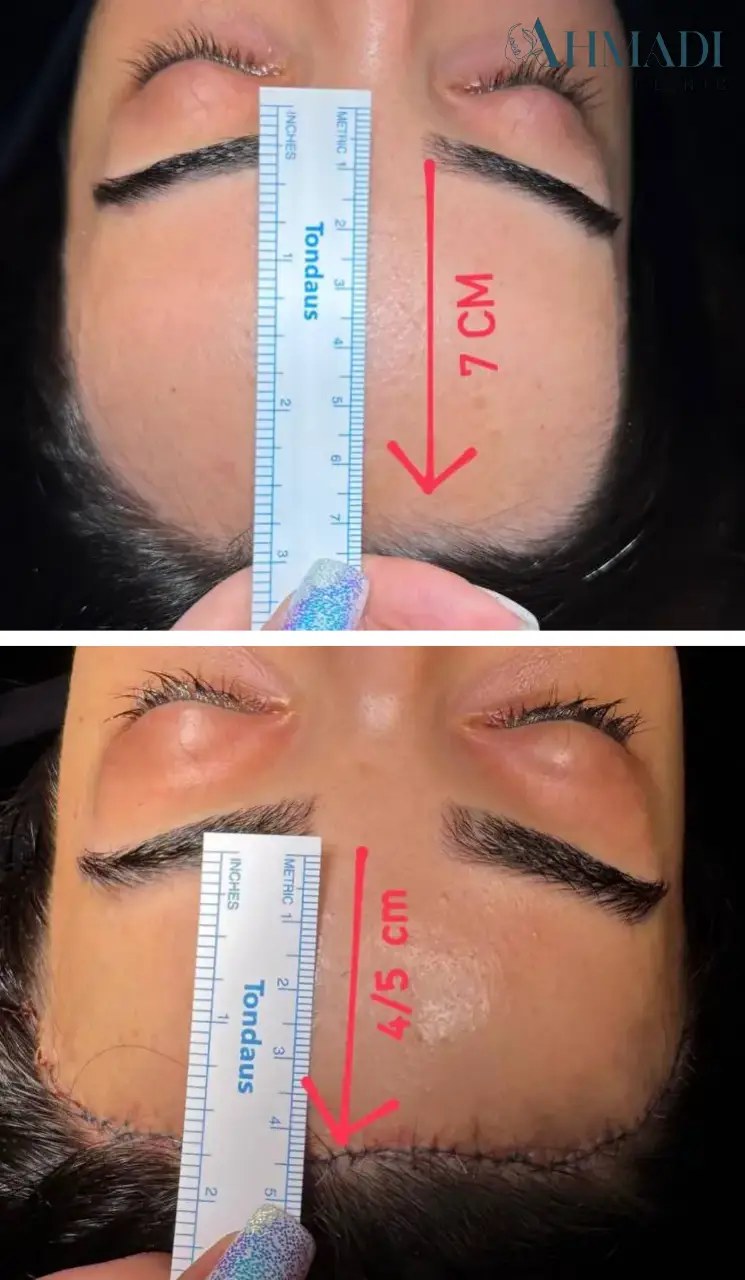

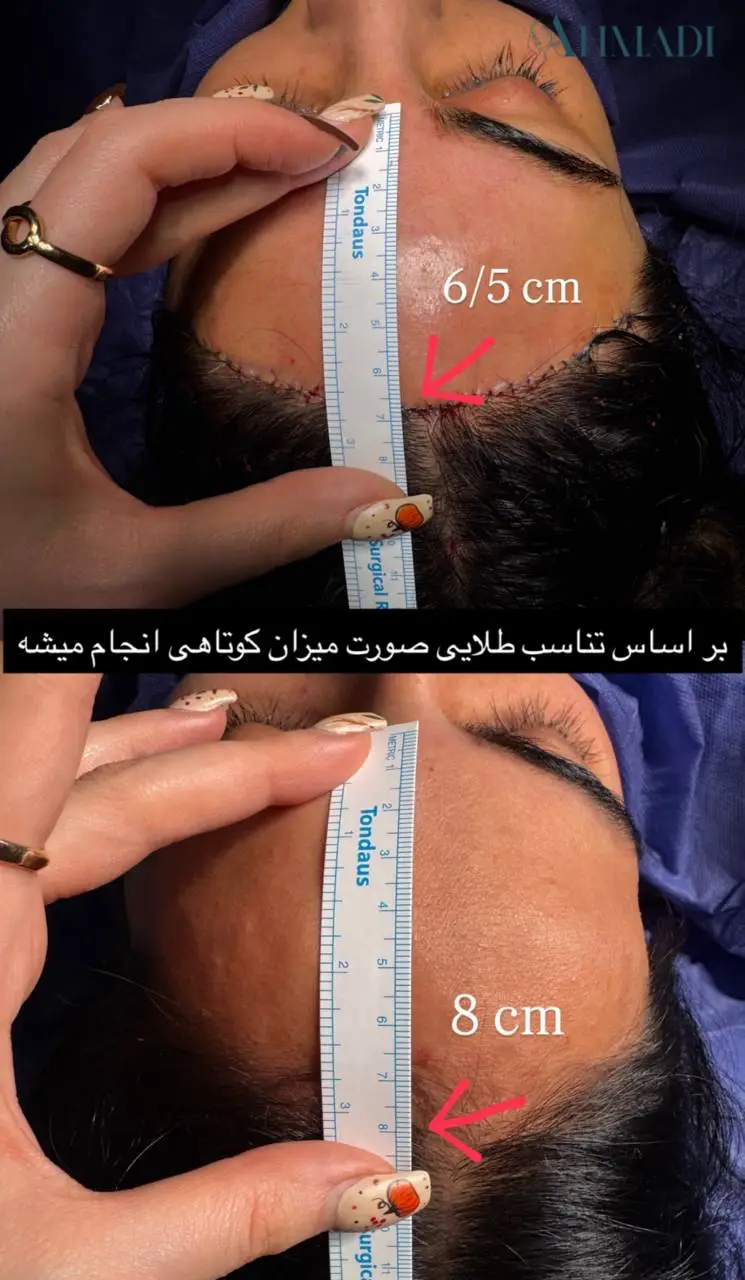

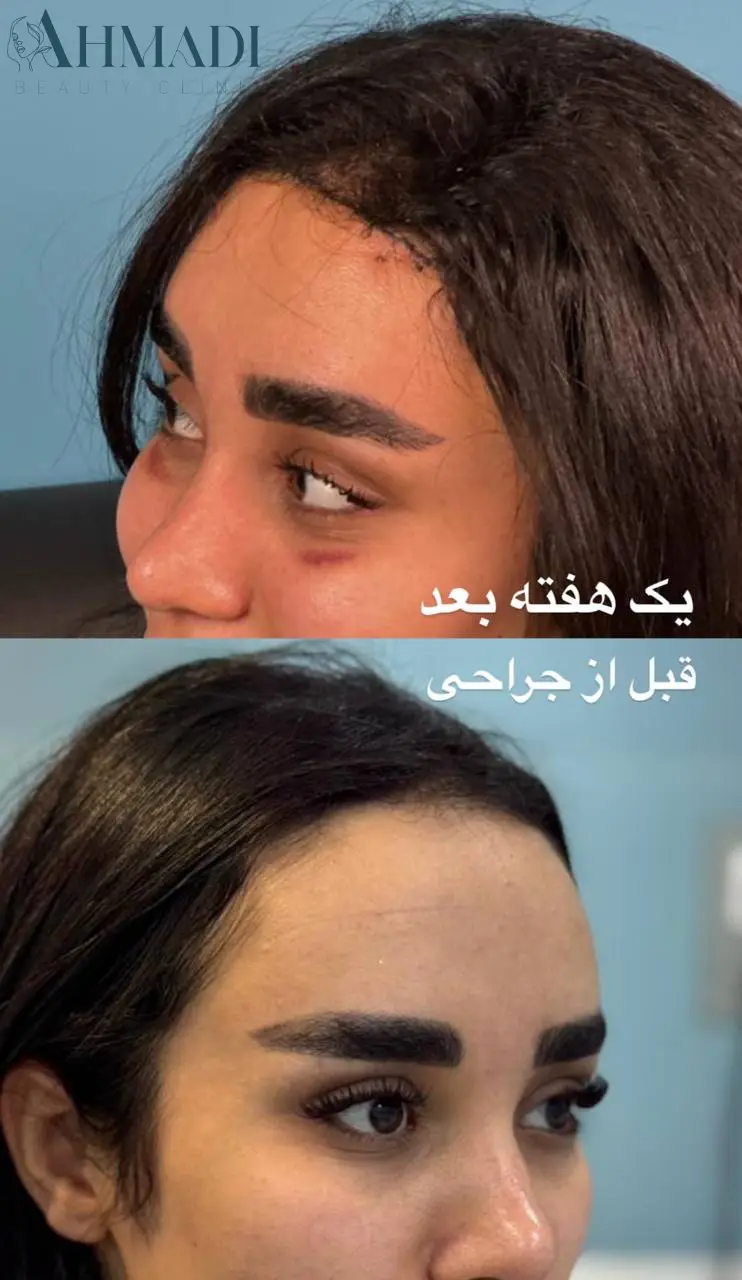

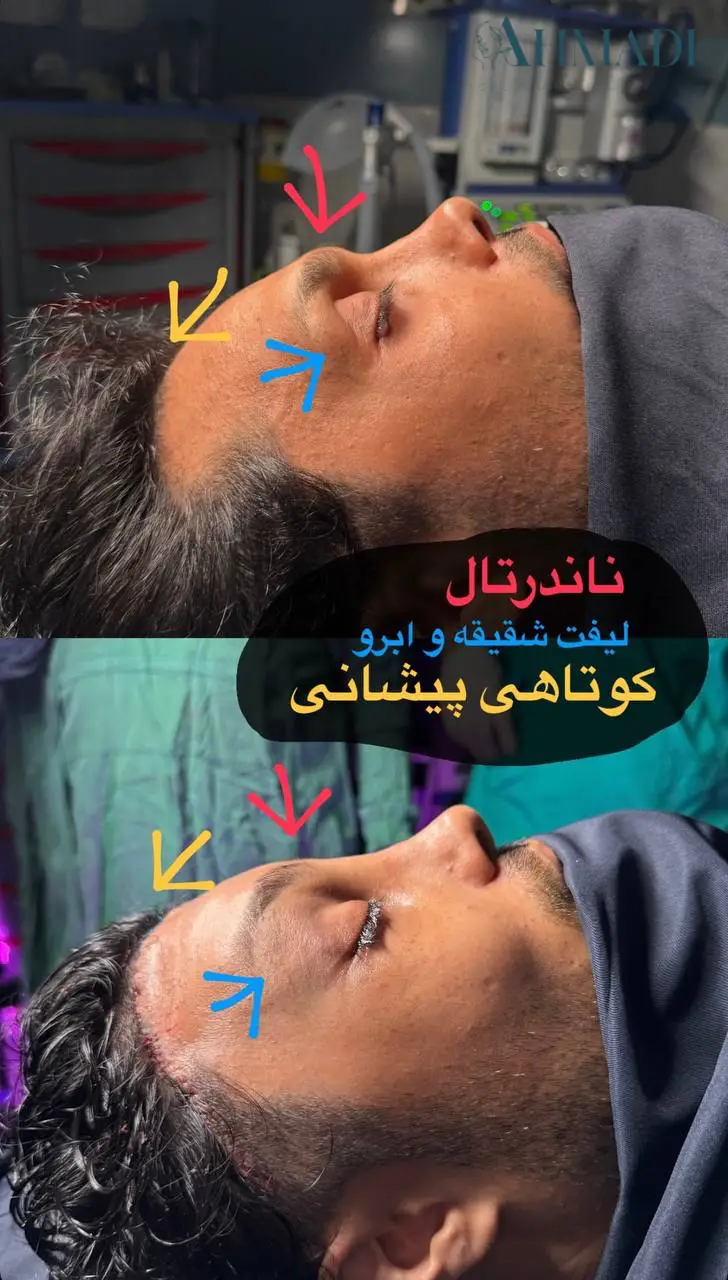

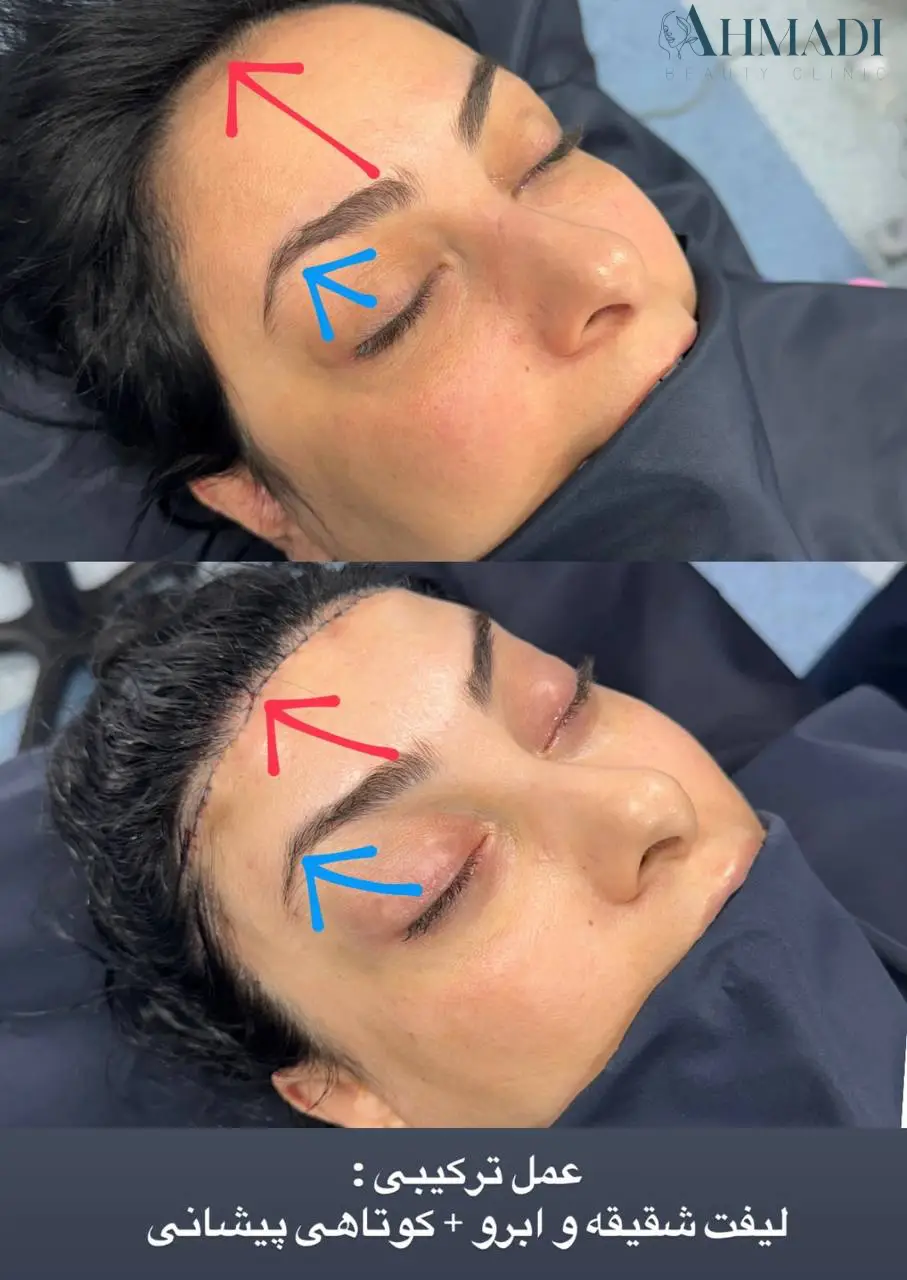

We checked additional galleries but could not confirm that their images were actually of hairline lowering; several were forehead lifts or facelifts. For that reason the gallery stops at five verified, distinct provider examples instead of filling ten spaces with mislabelled pictures. Ask the surgeon for more full-size, dated cases similar to your anatomy. You can explore Hamintour Medical’s wider before-and-after collection and our forehead aesthetic examples, checking the exact operation named for each image.
About Hamintour Medical and the support package
Hamintour Medical is an Iran-based medical travel coordinator. We help international patients identify possible providers, arrange introductions and consultations, transmit records for an initial clinical review, and coordinate the practical side of a trip. On request, that can include flight and accommodation booking, airport and local transport, a translator or companion, scheduling tests ordered by the clinician, support during the stay and help reconnecting with the treating team after you go home. You can ask for only the elements you need.
Hamintour is not a hospital, clinic or treating medical team. We do not diagnose, prescribe, operate or promise an outcome. The treating licensed surgeon and facility decide whether surgery is appropriate, explain risks, obtain informed consent and provide care. Our responsibility is to make the comparison, communication and travel process clearer. Learn more about Hamintour Medical and browse the Iran medical travel magazine.
Frequently asked questions
Is forehead reduction the same as a brow lift?
No. Hairline lowering moves the existing hair-bearing scalp to reduce visible forehead height. A brow lift repositions brow tissues. A person may be offered both, but the effects and risks must be explained separately.
Can hairline lowering replace a hair transplant?
Sometimes scalp advancement is suitable for a high, stable hairline. A transplant adds follicles and may be more relevant for temple recession or sparse density. Scalp mobility, donor hair and future hair loss influence the choice.
How many centimetres can my hairline move?
There is no reliable universal number. Published study averages describe selected patients, not your anatomy. The surgeon must assess scalp laxity and draw a realistic plan during consultation.
Will the scar disappear?
A surgical incision leaves a scar. Its visibility varies with healing, hair density, hairstyle, technique and later hair loss. Ask for mature scar photographs and discuss your individual scarring risk.
Are the five photographs five guaranteed outcomes?
No. They are distinct provider-published examples, two of which involve combined surgery and one of which is labelled as an early, one-week result. Photographs cannot predict your own outcome.
Is US$2,000–5,000 a confirmed price?
No. It is a broad, approximate range appearing in public Iran travel listings, not a current surgeon quotation or Hamintour transaction median. Ask for an itemized USD quote that names the surgeon, facility, anesthesia and follow-up.
When can I fly home?
The treating surgeon must decide after examining your healing and completing the planned reviews. Keep bookings flexible and ask about travel risks before the operation.
Who provides care if I have a problem after returning home?
Arrange a local clinician in advance and keep the overseas surgeon’s contact details and English operative record. Hamintour can facilitate communication but does not replace medical assessment.